As its name suggests, the Spruce Grouse is most at home within northern forests of pine, fir and spruce trees. A strikingly beautiful bird, Meriwether Lewis of the Lewis and Clark expedition once described the Spruce Grouse as “gentle”, which may be another way of saying “approachable”. We spent nearly an hour in close proximity to this male in full breeding regalia who showed no sign of concern with our presence.

I have only seen this grouse in New Hampshire one time. Ranji spotted a pair going up the Mt Sunapee trail many years ago, dining casually on the fallen needles of pine and the flowers of undergrowth. Given the vast range of forest available to them Spruce Grouse are not particularly threatened, but there are few bird species as strongly linked to the direct and indirect effects of climate change and forest management.

Spruce Grouse can resemble ptarmigan (Churchill 2) in size and shape, but in addition to some superficial differences in size and appearance, the Spruce Grouse is not as muscular – and flies only in short spurts of a few dozen yards. We spent our time calling him into range and even setting up a few props, inducing photos, like this flight shot, that might otherwise have been difficult to achieve.


I hope you enjoyed the series, thanks for all the encouraging comments. I have nothing planned for the near future, but you can be sure I am working up a few ideas. Lastly, it has been suggested that I set up an "auto-enroll" option to eliminate confusion about opting in for future ZenBird emails. Click here to send me a quick note if this option appeals to you.
Best,
Bo
]]>
While photography was the primary purpose of our trip, including both field work and some digital darkroom time to clean up the images, the birding alone was spectacular. I tallied about 100 species across the nine (cold, rainy) days I was there. And of course I was learning all the way. In one shooting session alone there would typically be several different species to consider. As a quick illustration, here are four additional shorebirds from the tundra:
Stilt Sandpiper, with its long legs and decurved bill; dressed in reddish cheeks and crown

Lesser Yellowlegs, similar in size but with bright yellow legs, long neck and slightly smaller bill

Short-billed Dowitcher, smaller, chunkier, and shorter-billed than the others. In breeding plumage, an orange cast helps to distinguish them.

Sora, the smallest of them all (a member of the Rail family) with shorter green legs and massive feet (just visible in this picture).

So, despite the tough weather, there was plenty to go out and see, learn more about from both the guide and the group, and of course work on getting the best pictures we could.
Tomorrow will be the last installment for the Churchill series.
]]>
The Red-necked Phalarope, a member of the shorebird family, is functionally among the world's smallest seabirds. It spends up to 9 months of the year at sea, feeding on tiny plankton far out to sea. In New Hampshire we find them near Jefferies Ledge, an undersea ridge about 20 miles east of Rye Harbor. Red-necked Phalaropes are famous for "lifting" aquatic prey within reach by rapidly spinning in tight circles; a bit like a wobbling wind-up toy.

Female
Churchill is their most southern location breeding ground. About the size of a spice jar, we saw these tiny birds regularly – happily doing their circling dance for food. Unlike most species, phalaropes (there are 3 worldwide), have their sex characteristics reversed; breeding females are brighter than males and are slightly larger. And it’s the females who fight ferociously over males, which go on to provide all parental care for the young.
 Male
Male
To get these shots I was back on my belly (shipping a bit of water into my waders) trying to keep the camera dry. Plus, the conditions remained foggy, so I needed to be close. While I am familiar with all 3 phalarope species, these are my first decent photographs, and the only ones in breeding plumage. Here is a picture from Jack to give you a sense of conditions
]]>
Reaching weights up to 6 lbs., the Common Eider is the largest duck in the Northern Hemisphere. It generally inhabits arctic and subarctic coastal shores although I see them regularly along the New Hampshire coastline in winter. Its tendency to nest in large colonies inshore coastal areas marks Hudson Bay as a prime breeding territory.

We went to the mouth of the Churchill River, where huge ice blocks were still being driven up against the shoreline from the northerly winds. Our goal was to photograph birds in flight, trying to use the terrain as context and composition. We struggled with poor visibility most days and while the birds were numerous, they were far generally too far away for my setup. Nevertheless, we eventually succeeded with a few eiders coming closer by.

Common Eiders are known to be seasonally monogamous, and in some populations show long-term pair bonds. This flight shot presents the black & white male with its large yellow bill and the all brown female.
This species has been exploited throughout its range. Market hunting nearly wiped out the American race from the eastern seaboard of North America by the end of the nineteenth century. The Migratory Bird Convention (1916) designated special protection to eiders (note: from these birds come much coveted eiderdown) and largely ended this excessive commercial hunting.
]]>
The Hudsonian Godwit is a large shorebird with long legs and a long, slightly upturned bill. During the breeding season adult males have dark–reddish underparts with scattered darker barring and blackish upperparts with variable pale spotting. In both sexes, a white stripe extends across the wing; and the bill is bicolored, with a pinkish–red base, becoming orange in males during courtship, and with a dark tip.


The Hudsonian Godwit is one of the world's four godwit species. With the majority of its population restricted to only a few remote sites during much of the year, it was long regarded as one of the rarest birds on the continent. Starting in the ‘40s biologists began to discover large migratory flocks near the Hudson Bay, leading to the realization that the status of the species was not as dire as it had seemed and solidified “Hudsonian” in its name. The “Godwit” part is harder to pin down, but most agree it traces from the Medieval English “good wight” meaning “good creature” - perhaps because they were tasty and birds with desirable meat often acquired favorable names.

As Churchill is a principal breeding location, the birds were abundant and we saw them each day. We practiced acquiring flight shots and tried to compose wading birds in favorable light (despite the constant rain). Our guide, Glenn Bartley, took this shot of myself along with new pals Dave (Stewart) and Jack (Hochfeld) emerging from just such a session.
This beautiful species is listed as highly vulnerable, in part as the global population of between 50,000–70,000 birds occurs at only a handful of fragile South American sites during the nonbreeding season. While I have seen and photographed them off and on in New England during migration, I was glad for the opportunity to get close to them on this trip.
]]>
A true arctic species, the Long-tailed Duck breeds in tundra around the globe. Churchill is the southernmost part of this range which extends as high as the northern tip of Greenland.

In addition to the obvious white eye patches, the breeding male displays 2 slim and elongated central tail feathers (hence the name). In summer, white feathers on the head of the male are replaced with black as these ducks migrate to cold water regions in North America.
Researchers have found these ducks can dive more than 60 meters deep in search of food, further than any other duck. This helps explain why they can be seen relatively far offshore in our New England winters. This male was defending its territory in a freshwater pond just north of town. The evening light throws an orange cast on his displaying posture – throwing his head back dramatically while calling loudly.

The Long-tailed Duck is hunted throughout its range, by native hunters in the North and by recreational hunters in southern Canada and the northern United States. Obtaining population size and trend estimates for this species have proven difficult, as it usually winters in flocks of various sizes, is widely distributed, and can be far offshore. Bird Life International suggest the population may be in dramatic decline and lists the species as Vulnerable
]]>
Within its vast northern breeding range, the Horned Grebe selects small ponds and lake inlets containing a mixture of emergent vegetation and open water. Its floating nest is usually concealed within the vegetation, and our search for them depended upon their intense territorial behavior. By mimicking the courtship sounds of another pair, we were able to draw a local pair into view for an extended photography session. Lying prone in our waders at the water's edge we tried to remain as inconspicuous as possible while waiting for them to slowly come close enough for a good shot. For context this small grebe is about a foot long and weighs about 3/4 pound.


This is another fine example to illustrate the difference in plumage that makes Churchill an rewarding destination for birders. The Horned Grebe acquires chestnut in the neck, breast, and flanks in spring to perform its intricate courtship displays. Its name obviously derives from the broad patch of tawny orange feathers (“horns”) extending behind the red eyes back across its seasonally acquired bushy black hood. Our New England experience with this bird is much more muted. No horns and no additional colors to black/white/gray mix we find on our Atlantic shores during winter.

Although the Horned Grebe is among the most abundant grebe species in North America, Birdlife International ranks it a “Vulnerable”. In part this may be a lack of complete knowledge as most breeding populations occur in low densities at high latitudes, making it difficult to obtain population estimates. The Horned Grebe is also widely distributed within its North American overwintering range, rendering population assessment at that season equally difficult.
]]>
A regular denizen of arctic, subarctic, and subalpine tundra worldwide is the Willow Ptarmigan. This widely distributed ptarmigan is nevertheless restricted to the extreme north and previous to this trip I have only seen them in Alaska.

As with the Snipe (Monday’s bird), this is my first time photographing them. This hardy and tenacious species has developed a variety of adaptations for living in extreme northern environments, where temperatures and light levels vary dramatically and predators abound; feathered feet that function as snowshoes, use of snow burrows for shelter, and a complex pattern of molting for year-round camouflage.

In non-breeding plumage (winter months), adults are entirely white, except for black tail feathers, to blend with a snow-covered environment. As the breeding season approaches, both sexes begin to acquire feathers of various shades of brown, appearing brown and white in concert with the changing environment of receding snowpack and emerging vegetation. In males, the head and neck become rufous brown, and the rest of the body is white. Both sexes have red “combs” above the eyes.
This adult male was photographed in the early evening after a steady rain. We called him with a recording of male on territory, which set our bird on edge as he flew in to explore the perceived intrusion. Fearless in front of the camera, we composed our shots from a low angle to incorporate the newly flowering purple saxifrage while forcing the background into a deeply blurred collage of complementary forest-edge colors.
]]>
While I did not expect to add any “new” birds to my life list, a trip to Churchill provides a rare opportunity to see species on their breeding grounds. This means they are also in full breeding plumage, which in many cases, is vastly different from how I get to see them in migration.

A splendid example is the American Golden-Plover. The adult male Golden-Plover is an “aristocrat among birds”. The jet-black breast and belly, the golden speckled back and brilliant white head markings of the breeding plumage make this bird instantly recognizable. From a photographer’s point of view, not only do these markings combine for an elegant study, but the bird characteristically maintains a quiet demeanor in the field. Often standing still among an open field of rocks and grassy scrub, a patient photographer has many chances to capture a pleasing image. Churchill is the most southern location for these plovers to nest and raise their young from June to August, so it was high on our target list to find suitable nesting grounds.
Contrasting this profile, their appearance in other months is markedly more muted. The September photograph below shows a juvenile bird on its migratory path to winter in Argentina. Taken in Stamford, CT this is how a New England birder will see the plover for only a day or so as it rests to feed on local grasslands before continuing its 6,800 mile bi-annual journey.
While not necessarily a species in decline, these plovers, like other shorebirds, are under increasing pressure. Overwintering ranges and migratory routes are variously threatened by unfavorable agricultural practices and land conversion to non breeding habitat including residential development.
Note: I often use Cornell's Birds of the World, among other sources, to help compose my emails, including the quote above. Just sayin.
]]>
I have just returned from a week-long workshop on bird photography in Churchill, Manitoba. Churchill, midway up the western shore of the Hudson Bay, is a bucket-list destination for birders in early summer as hundreds of species come to breed across three converging biomes: the boreal forest, the subarctic tundra, and the Hudson Bay marine coast.
The region serves as a massive migratory funnel to pristine breeding grounds in Churchill and further north, offering birders the ability to target highly sought-after Arctic species that are otherwise difficult to find. To work on the fieldcraft of bird photography, we explored the mouth of the Churchill River for ducks (and Beluga Whales!), the forest for sparrows, warblers & grouse, as well as the tundra (waist deep in fishing waders typically) for shorebirds.

The Wilson’s Snipe is a great example of targeting these breeding grounds to find an otherwise elusive species. Abundant in North America, they are more often heard than seen unless unexpectedly flushed. Each day we heard the “winnowing” sound produced by the tail feathers of snipe as they circled overhead to attract a mate or otherwise defend their chosen breeding location. While I have seen Wilson’s Snipe in almost all our New England states, I had never photographed one.
Snipe are members of the Sandpiper family and their long bills are tipped with sensing nodes to detect prey while they probe the mud for food. Their eyes are set back on the head to allow for vision on both sides, overlapping in the rear for full awareness of potential predators, even when the beak is fully submerged.
Including this email, I plan to share a new bird for each of the next 10 days. As always this is an OPT-IN opportunity to remain on the list for the remainder of this series. Please reply if you wish to stay on the list. Each submission will be brief (max 300 words) touching on a few characteristics of the bird featured and/or why I chose it.
]]>After several days at sea (and a bout of the flu for me) we crossed over 60 degrees south and officially entered the waters of Antarctica - just as the new year dawned. An excursion to aptly named Penguin Island brought us in close proximity to our 6th (of 7) penguin species on this trip, the Chinstrap Penguin.

The Chinstrap Penguin breeds on widely scattered islands throughout the Antarctic with the highest concentration of these breeding sites in the South Shetland islands (where we are). The Chinstrap Penguin is best identified by its white face and black bill along with the narrow “chin guard”, which is sometimes hard to pick out from a distance.
In addition to visiting the colony for easy viewing we also had numerous chances to see them in the water hunting for krill. Often coming quite close to the ship or our excursion zodiacs, the penguins porpoise fluidly in small packs. I had fun trying to capture these close encounters...
...including some just underneath the surface of these incredibly clear seas.
With krill abundant, the chinstrap penguin is rapidly becoming one of the most numerous penguin species and is not regarded as threatened. Nevertheless, Brown Skuas patrol the colony looking for unprotected penguin chicks to feed their own young.
]]>
Good morning:
We are entering our second day on South Georgia Island and the weather has been superb – a rare treat for this region!
The King Penguin is a large, spectacular, nearly iconic penguin that is rarely seen away from well-known colony sites. We visited two such colonies yesterday along northwest shores, the second hosting well over 100,000 birds.

The long bill distinguishes King from the even larger Emperor Penguin, which is a true Antarctic species, rarely seen far from ice. Note the golden neck patches and matching lower mandible. Young birds require 14 months before reaching adulthood, so fluffy brown birds can be seen year-round in these huge colonies.

A few more photos today than normal, as I was having fun playing with my camera while trying to capture a sense of the wonder of so many birds in this extraordinary landscape.

Not globally threatened, these penguins are locally common and abundant. The total population is estimated at more than 1,000,000 pairs. With no major land predators, and plenty of time ashore, it's not too hard to see why.


]]>
Certainly, one of the draws of a cruise to Antarctica is a chance to see one of the largest birds in the world: an albatross. To imagine their wingspans of up to 11 feet, place two people side by side, arms stretched to either side, positioned just so they can touch each other’s fingers.
The Black-browed Albatross is easily identifiable with its all white head and a black triangle around the eye. The body is white contrasting sharply against the black surface across the back and top of the wings. The bill is large and bright orange.

An albatross will only visit land to breed, sometimes spending years soaring the ocean before coming ashore to nest. On the Falklands we visited a colony of several hundred Black-browed pairs. Adults are monogamous and are thought to pair for life. After each bird navigates the Southern Atlantic Ocean independently for 10 months, once paired, they reunite at exactly the same spot each year to mate.

There are 22 species of albatrosses and all but the Black-browed are at risk. Numbers of albatrosses are in decline primarily from predation by new species introduced (by man) into their nesting habitats with rats and feral cats targeting eggs and young chicks. Longline fisheries pose major threats to the adults at sea, as feeding birds get attracted to the bait, become hooked and drown. Ingested plastics are another major concern.

On this trip there may be a chance to see up to six different species of albatross; I will be on deck each day scanning!
Penguins are not the only flightless bird in this area. There are three species of “steamer-ducks” in Argentina – and one is endemic to the Falkland Islands. Steamer ducks are so named because, when swimming fast, they flap their stunted wings into the water as well as pushing with their feet, creating an effect reminiscent of old style paddle steamers.
The Falkland Steamer Duck is a large heavy-set duck that is found along the coast, where it favors small rocky islands, as well as sheltered inlets and bays. Weighing up to 10 pounds, it rarely ventures farther inland, preferring low-lying coastal areas and relatively nearby ponds. Adult males have a bright orange bill; in females and juveniles, the bill is olive-green.

Not all streamer ducks are flightless, however, and the Falklands is also home to the Flying Steamer Duck which is similarly built but with normal (load-bearing) wings. As such, steamer ducks are currently in a transitional zone from flight to flightlessness, presenting a unique opportunity for researchers to study the evolution of flight loss while the transformation is still in progress.

Despite their inability to fly, the Falkland Steamer Duck is widespread and common throughout the islands. Chicks have a high mortality rate due to predation by Kelp Gulls and Brown Skuas, but adults have no enemies except from the occasional sea lion.
There are generally considered to be 18 recognized species of penguins in the world, with most living in the Southern Hemisphere ranging from Antarctica to the equator. Our journey in the Southern Atlantic Ocean should let us see 7 of the 8 resident here (we will likely miss the largest of them all – the Emperor Penguin – as they will have retreated deep into Antarctica to breed.
Gentoo Penguins breed in shallow coastal areas like the ones seen here near Grave Cove in the west Falklands. They are easily distinguished from other penguins by the white head patch (“headphones”) that span from ear to ear. This is probably where their name was derived, but there are a few competing theories on just what "gentoo" actually means.


]]>
We left Ushuaia in Tierra del Fuego, Argentina in the evening and headed east toward the Falkland Islands. I was hoping for time to bird in the port but that was not to be given the logistics of getting on board our (very comfortable) ship.
Early on in the journey we picked up a few seabirds, but none more frequent than the Southern Giant-Petrel.

As the name implies, these birds are the largest members of their family with wingspans approaching 7 feet and can typically weigh over 10lbs. Petrels are in the family of "tube-nose" birds with one large nostril giving them an extraordinary sense of smell for seeking food at sea. They pick up the scent and follow our ship as they would a fishing vessel in search of scraps. On land, Giant-Petrels are scavengers and use the tremendous power of their large beaks to ravage seal carcasses or hunt penguin chicks.
Near the top of its food chain, the Southern Giant-Petrel is more predator than prey and its conservation status is secure. Abundant in the Southern Atlantic Ocean, these birds navigate throughout the range of our journey to the Antarctic and I expect we will see them daily.
Tomorrow morning we should arrive on the western side of the Falklands for our first trip ashore.
]]>
Welcome to the last day of the Costa Rica bird series. Thanks for sharing these past two week of birds from the tropics.
In the US we proudly (if only somewhat recently, at least officially) promote the Bald Eagle as our national bird. Symbols like this represent the self-proclaimed identity, values and natural heritage of a county. From Wikipedia: "A national bird...embodies qualities that a nation wishes to associated with, such as strength, freedom or resilience".
We have seen some beautiful birds over the past ten days and many are indeed emblems of Central American countries: Resplendent Quetzal (Guatemala), Turquoise-browed Motmot (El Salvador and Nicaragua) and the Toucan (Belize) among others.
Forgoing the choice of a more recognizable, colorful, beautiful bird associated with the tropics, Costa Rica took a different approach to selecting their national bird. Instead, they decided to honor a bird that can be seen by everyone who lives in and visits here – the ubiquitous (but decidedly bland) Clay-colored Thrush!

Costa Ricans revere this bird for its abundance and ease of observation, its charismatic nature in suburban gardens and most of all, its melodic song. The dawn song of the Clay-colored Thrush is sweet music to everyone’s ears, historically linked to the beginning of spring and signally the beginning of the coffee planting season (which before tourism, was the mainstay of the Costa Rican economy).
Here is the song, which is highly reminiscent of our our American Robin.
Until next time...
Note to the list: While researching the Clay-colored Thrush I came across the website of WhiteHawkBirding where i selfishly used (nearly verbatim) the reason for Costa Rica's selection. That site also discusses the significance of the other Central American selections, in case you are interested.
]]>Members of the toucan family are instantly recognized by their enormous and colorfully patterned bills. "Toucan Sam" has adorned the Fruit Loops cereal box for over 60 years, adding to the birds' familiarity in popular culture. The large beak of the toucan is used to obtain food and also regulates the body temperature. It consists of the same material as our fingernails and is very lightweight, otherwise the birds could never fly.
All 42 members of the toucan family are found in the neotropics and 6 are in Costa Rica. They sort out into 3 general groups by size and habitat: large (toucans), medium (toucanets) and smaller (aracaris)
The Northern Emerald Toucanet lives in the montane forest and is more shy and less vocal than its toucan cousins. The body primarily is emerald-green, with chestnut coloration under the tail. The color of the throat varies geographically and may be whitish or blue. The bill is long and mostly black but shows yellow on top. While this bird is roughly the same size as a blue jay, it looks bigger due to the size of its head and much larger beak.

The Collared Aracari is more the size of a woodpecker. The head, throat, breast, and upperparts are black, with a slight rufous band (the collar) across the breast, and bright red lower back. The underparts are yellow, and the bare facial skin is red. Aracaris typically have a longer and narrower bill than toucanets.

Like many of the birds we have already seen there is no immediate concern for their populations. The threat is nevertheless present; populations of toucans, toucanets and aracaris are in a slow decline due to habitat loss and the longer-term changes in climate.
]]>
No birding trip to Costa Rica would be complete without a lot of time spent looking at hummingbirds. I just checked my list, and we recorded 29 species over the 7 days of birding. Hummingbirds are a delight to watch, flash amazingly brilliant colors (which are surprisingly hard to capture in pictures), and are so abundant they go by a variety of names, including: Hermits, Sabrewings, Emeralds, Lancebills, and Woodnymphs just to share a few.
I must have spent more time trying to photograph hummingbirds than any other bird. But even when they come into feeder stations - which they love to do - the speed at which they zip around means hundreds of shots are required to get one fairly decent image.
While there was no particular favorite, the White-throated Mountain-gem stands out as a great example of a common representative of the group, and one where the female has as much to show off as her partner. While the male offers a brilliant blue

forehead, green breastplate and snow-white throat, the female is cinnamon colored from neck to belly with brown wings, green back and a delightfully long white head-stripe that runs down behind the eye. Both birds have relatively short and straight bills compared to other hummingbirds.

The White-throated Mountain-gem is endemic to southern Central America and occurs mainly in Costa Rica. Conservation-wise we see a mixed message. Despite its small range, this bird is not particularly threatened...yet. As is true of many species restricted to montane forest, though, the most significant long-term conservation issue facing the White-throated Mountain-gem is probably the contraction in suitable habitat caused by climate change.
In Costa Rica, 50% of hummingbird species studied are projected to decline in abundance and 16% are predicted to become locally extinct within the next century. Some of this will be habitat loss, but some will also be pressure from lower elevation species moving up into higher elevations as overall temperatures warm.
]]>
As I mentioned in a previous post, owls were a target on the trip, and I ended up seeing 5 different species. Some of this was luck, but mostly the result of my guide, Anthony, having enough local contacts to get us onto know roosting sites.
The Spectacled Owl is a common resident of both the rainforest and dry forest. It occurs throughout the tropical regions of South America from northern Argentina to southern Mexico. Due to its reclusive and nocturnal habits, it is seldom seen (unless you have a guide!). A large owl (20+ inches tall), it can hunt mammals up to the size of opossums, rabbits, and skunks.
Adults are very dark brown, with prominent white eyebrows, pale bill and buffy breast with broad chocolate-brown breast-band.

Juveniles are completely white with a black face mask and yellow eyes. The young bird in this picture is 2025 vintage but it can take up to 5 years to completely shed the white and reach adult plumage.

These owls are abundant in their region and rated "Least Concern" by conservationists.
]]>
Curassows are a member of the large and elegant birds of Neotropical woodlands and forests. Historically prized as game fowl, they were often the first birds to disappear once “civilization” had arrived. As a result, curassows tend to be quite shy, and encountering a lingering curassow on a forest trail can be the highlight of any morning afield.
The Great Curassow is a particularly large (turkey-sized) member of this family whose range extends from Mexico south to Ecuador. It is a somewhat secretive species found in humid tropical forests that feeds mostly on fruits but also eats small invertebrates as well as vertebrates. Males are black with a shaggy crest and a bright yellow spherical knob on the bill.

Females are typically less dramatic in color, featuring browns, blacks and rufous tones. She also sports a distinctive black and white crest.

As you might expect, like many others in the group, this species is declining due to habitat loss and overhunting. Overall, the population is estimated to be fewer than 40,000 individuals. and it has been extirpated from some parts of its historical range. In Costa Rica, (where it in no longer hunted) good populations persist in some national parks (where these pictures were taken).
]]>
A couple days ago the post was on Tanagers, and here is another member in that huge family of birds.
Shining Honeycreepers are small tropical tanagers. They occur from southeastern Mexico to extreme northwestern Colombia. Honeycreepers are distinguished among other tanagers by their long, slender, decurved bill used for nectar feeding. They are found moving busily about the canopy poking into a seemingly unlimited variety of flowering plants.

Like many tanagers, males and females present differently in the field. The male Shining Honeycreeper is deep blue and black with bright yellow legs and toes. The female is green above and buff or creamy below, streaked with green and light blue on the breast and also shows yellow on the legs and toes.

In the field we would often be on the lookout for mixed flocks of birds, essentially looking for activity where a variety of species might be converging on a common food source (often a large colony of ants). The Shining Honeycreepers we found were frequently in a mixed flock of other tanagers - and pictures like these were taken at "staged" locations where food was as an attractant. As such, this species is considered to be common, and its conservation status is rated as "Least Concern."
Notes to the list:
First, a quick shout-out to Laura who asked, given all the diversity how do we define "tanager". This sent me down the rabbit hole in part because "tanager" is not by itself a defining term. Rather it is a collection of mainly colorful songbirds of the tropical forests in the Americas that have been grouped together because they share a number of broad morphological similarities (mostly dealing with "perching" and "singing") even though they have many different distinguishing attributes (like the bill of the honeycreeper). Unhelpfully, some birds we still call "tanagers" aren't even in this family. In North American we have Scarlet Tanagers, Western Tanagers and Summer Tanagers - all of which are actually grouped in the Cardinal family. Welcome to birding!
Second, Joe asked if i could link the vocalization of the Great Potoo to the post. I was able to do this via the Cornell Lab. If you want to hear it, go back via "previous post". The link is now at the bottom of that page. The first call is about 20 seconds into the recording and repeats three times in the first minute. Remember to hit the "play" button.
Finally, recall no postings on the weekends. See you next Monday.
In the past I have shared some owl pictures (and may yet again as I saw 5 species of owl in Costa Rica). In this post, however, we look at a member of a different nocturnal family: Potoos.
Despite some obvious similarities, Potoos differ from owls in many ways. Potoos are less active than owls, preferring to hunt only at night from its solitary perch, on which they remain motionless during the day. They have small, weak feet which limit their ability to catch any prey other than insects. Correspondingly, the beak is also small but opens to an extremely wide mouth, better for sweeping up airborne prey and less so for tearing into flesh the way owls do.
The Great Potoo is the largest of the 7 species distributed throughout humid and forested habitats in Central and South America. This picture shows a typical daytime posture, remaining motionless and well camouflaged, mimicking a tree stump.

The tail on this bird is also much longer than those found on most owls providing more stability while perched for long periods. Finally, the eyes of Potoos are exceptionally large and may actually be "open" when they appear closed as the eyelids have slits, an adaptation of additional camouflage, allowing for the detection of predators without necessarily giving away its position.

I had never seen a potoo before and was delighted when my guide, Anthony, reported that one had been discovered in a fairly accessible location. The Great Potoo has a large range and population so although the population appears to be decreasing, it is not a rapid enough decrease to cause alarm. This particular bird was roosting alongside a freshly worked field, so they appear well habituated to farms and cultivated land.
]]>
The Motmot family of birds is also restricted to the neotropics and of the 14 species nearly all are found along the edges of Central American rainforests. Across the family they share colorful plumage, a relatively heavy bill and long tails.
The Turquoise-browed Motmot is surely one of the most flamboyantly plumaged of this remarkable family, Olive-green underparts, rufous belly, and a darker reddish patch on the back, turquoise flight feathers with a similarly colored eyebrow contrasting with the black mask, make this bird as handsome as they come. Then, of course, there is the long graduated bright blue tail, which has the central feathers twice as long as the rest which terminate with black-tipped turquoise rackets. Research suggest the tail (present in both sexes) may be wagged as a warning to predators, making the bird appear much larger than it actually is.

One of the most abundant motmots the Turquoise-browed is common throughout Costa Rica and has adapted well to semi-open country in areas much altered by man.

In the Sri Lanka series we looked at the Asian Green Bee-eater. Bee-eaters and Motmots are in the same family group and share the characteristic that they nest on banks or along slopes in caves and short tunnels.
]]>
Good morning:
It may not be true that the Tanager family of birds excites more birders than any other, but it does for me. At last count (which researchers keep updating) there are more than 375 species of tanager – almost all restricted to the neotropics of Central and South America. They are abundant, active, and beautiful. I once birded in Ecuador and saw over 40 species of tanagers in a single tree!
Tanagers comprise some of the most stunning and idiosyncratic combinations of colors and patterns found among any birds on the planet. As a group, tanagers also have a vast variety of bill shapes, so while some species favor insects, others concentrate on fruits, nectar or grains.
Instead of concentrating on one species for this installment, here are some representatives of this large family:
Crimson-collared Tanager

Silver-throated Tanager

Blue-and-gold Tanager

Emerald Tanager

Slaty Flowerpiercer

]]>
I have just returned from a 7-day birding trip to Costa Rica. 320 species were listed along the way, and I have 10 pictures to share. If you receive this email, you have either previously expressed interest in my pictures or are being invited to opt in to this series. To opt in, please reply accordingly and I will send one email a day over the next two weeks (sample below). If you prefer not to have these bomb your inbox, simply ignore this email and I will drop you off the list for this series.
As a teaser, the series starts with one of the iconic birds of Central America: the Resplendent Quetzal.


With its golden-green iridescence, uniquely long tail (for males, seen here), bushy head and contrasting deep red, black, and white plumage, this bird a delight for birders and everyday tourists to see. Despite being almost 2 feet high (including the tail), quetzals can be hard to find within a canopy of contrasting greens. Being shy and somewhat soft spoken does not help. Throughout the trip I only saw 3 individuals.
Quetzals are non-migratory and depend on fruits of the cloud forest for nourishment. The only quetzal in Costa Rica, and the largest member of the Trogan family of birds, the Resplendent Quetzal is undergoing a steady population decline due to deforestation and habitat loss. Its conservation status is “near threatened”.
Note: if you are new to the list, this is the 8th installment in a series of bird pictures I sporadically send around. Other trip summaries have included Alaska, Hawaii, Rajasthan (India), Sri Lanka, the Plains states, Southern Arizona and Central Park. I use my blog page to save these emails which can be found here: https://bohopkins.zenfolio.com/blog.
]]>
As the last on this Central Park series I really debated on this one. But in the spirit of balancing both content with image, I have pulled three photos out of the files for Yellow Warbler.
Yellow warblers are abundant and breed almost throughout the United States after wintering in Central and South America. They are among the most vocal with a pleasing “sweet-sweet-sweeter than sweet” call from low in trees and on top of small shrubs. They are among the most dependable arrivals to Central Park in early May.

Drenched in yellow, males (above and last) are nearly golden in color with reddish streaks that practically pulsate from neck to belly. Females (below) are slightly less bright and show only a faint hint of the red striping.

After today I will take a break from posting. Thank you all for the comments and encouragement. I will plan to begin again when some trip or theme emerges. In the meantime I expect to keep trying to improve the photography and have fun outside looking for birds.
 ]]>
]]>I am often asked if I have a favorite bird, and for me the answer usually is driven by context. I suppose I have winter favorites, shorebird favorites and certain raptors. Spring is much harder to select just one because of the wide variety of colorful migrants to choose among. Certainly a contender is the Chestnut-sided Warbler.

Slim and long-tailed, breeding adults are crisply colored layers of yellow, black, white and a strikingly beautiful chestnut flanks. They are active feeders in migration and while many advance much further north, the breeding range begins in the Smoky Mountains and covers most of PA, NJ, and all the New England states.
 The song of the Chestnut-sided is a long and loud “pleased-pleased-pleased to meetcha” phrase that even my reduced hearing can still discern.
A favorite of mine?…..pretty darn close.
For me, nothing quite compares to the drama of the male Magnolia Warbler when it pops from the low understory for a few moments of study.

Males wear a black mask on top of a yellow throat and breast with a marvelous black necklace. They are gray above with white spots on the wing, tail and over the eyes.

Females are less dramatic with gray heads and bold white eye ring.

Magnolias breed in dense conifers such as a spruce and hemlocks from northern Massachusetts up through Labrador in Canada. They are less picky about their Central America wintering grounds, which means their populations are under less pressure than other migrants.
This week we are focused on Central Park birds and, more specifically, spring Warblers as they migrate through in May.
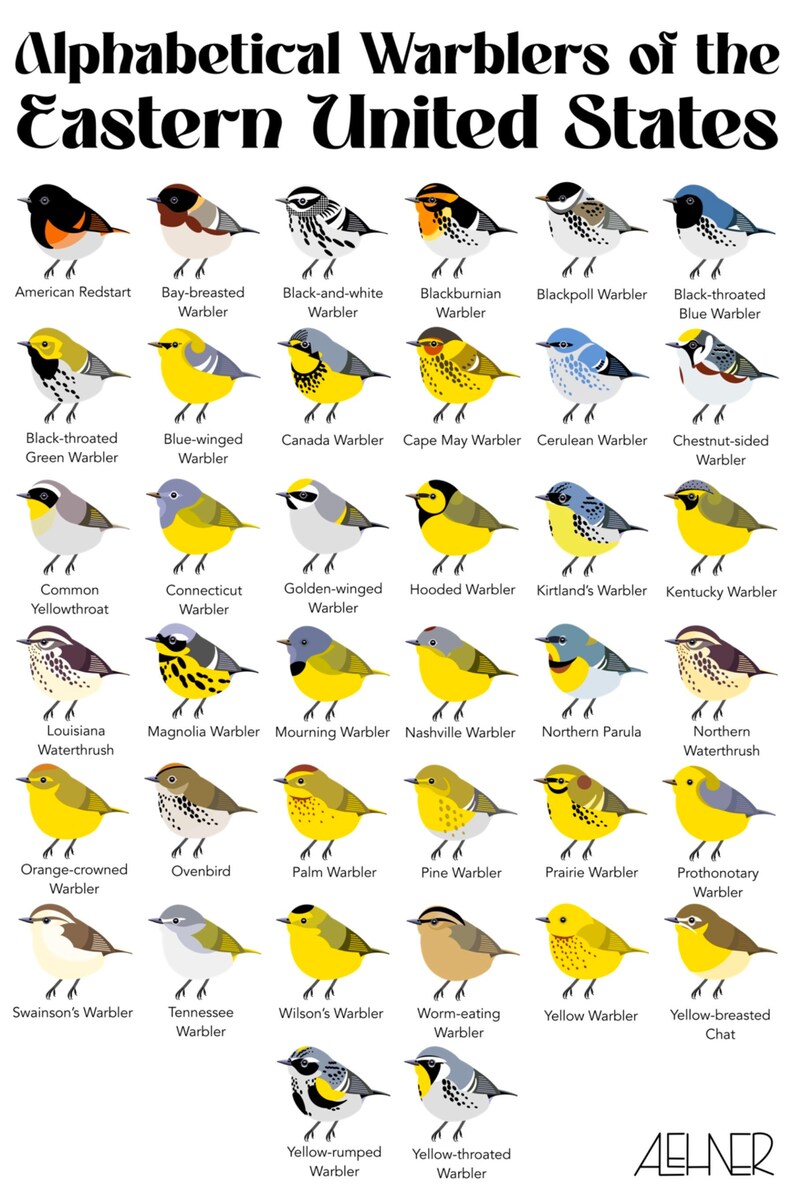
I am not sure I can say exactly what a warbler is, but as the joke goes, I know one when I see it. Generally they are a group of small, vocal, insectivores. Famously, many are yellow in breeding plumage and create a fair amount of excitement in the park for birders. As the graphic shows, there are nearly 30 warblers that can stop over for a night or two in the park enroute to breeding territories further north.
Another early migrant to visit the park is the Black-throated Blue Warbler (not so creatively named as others). If it is small and blue in May, there are only a couple of species possible, and this is the most likely.

The male is unmistakable; blue topside and white below with a rich black throat. While wings are a bit more gray, they are punctuated by the white “handkerchief” that seems to stick out of a side pocket on each side.
Females pass through a week or two later as males go first to stake out breeding territories. They are much more drably colored; gray green predominantly, but they too often show the white wing patch (not seen in the photo below)

The “Atlantic Flyway” is aptly named as a superhighway for migratory birds which runs from southern Argentina up through Nova Scotia along the Atlantic seaboard. It is one of four major north/south routes that has been engrained into the migration patterns of birds over thousands of years.

Along the routes special locations can act as key stopovers for resting and feeding. And Central Park in New York City is one.
On the right day in May it is possible to see 60 or more species of birds in just a few hours. With 850 acres of flowering trees and fresh water, Central Park is a veritable oasis in an otherwise concrete jungle.
Now is time for birds to come to birders! And, they dress for the occasion. Spring is breeding season and males of many species molt into bright colors with distinctive patterns. One of the first to arrive in the park this year was the Prothonatory Warbler. Preferring a swampy habitat, this bird is usually found near freshwater with thick vegetation. We get only one or two each year, and then only for about a day.

This male is bright yellow with gunmetal blue wings and tail (which is white underneath). Black eyes and a long, straight black bill complement the look. Females are similar, though not as bright. Their song is a series of high, thin notes that my ears can no longer pick up. Too bad, as there could be others I am missing.

]]>
Exactly 48 hours later (long drive and some chasing of birds behind us) and we are in Colorado on a lek for the Greater Sage Grouse. This time it’s just as cold, but more informal; pull your car over to the side of the road and wait sort of thing. We did and in they came about an hour before dawn.
 This is the largest of the “chickens” we saw. Mottled brown, males sport a lot of black around the head. But the defining feature is their fluffy white ruff that covers two(!) air sacs. Some process as the Prairie-Chickens but more so. As the air sacs expand, the head even sinks down into the chest before letting go for a mate-calling “boom”.

 We had nearly 30 individuals on this particular morning, including the smaller females, which made for quite a show. Often the males would square up for a stare-fight…
 … which could escalate if neither backed down. Brawls were fairly brief affairs with no lasting damage. And, girls seem to ignore the show completely.
 As you might be able to tell from the light, these pictures are presented in nearly reverse order. After a couple of hours in the car we were glad not only for the improved light, but also the rise in temperature.
]]>
It was a close call but I decided to double down today and present yesterday’s big brother - the “Greater” Prairie-Chicken.
Inside the trailer, with limited views, sometimes separating one Prairie-Chicken from the other is a matter of debate. Slightly bigger (you can’t really tell), slightly darker (you can’t really tell) and slightly louder (sure…). The best way is to observe the air sac, which on the Greater really is greater and much more orange than red.

Otherwise behaviors are much the same and while the Greater is more widely distributed, the ranges between the two do overlap.
The morning we were there no females were present. This limited the males to less than the full routine of foot stomping, jumping, bowing and otherwise strutting their stuff. But the displays are really worth it as is.
For a reminder, this one is the “Lesser” (from yesterday).
 Two cool “life” birds in one setting was, not surprisingly, rewarding just on that score alone.
]]>
At 5am in western Kansas March weather is, at best, unpredictable. I was bundled up in ski gear mostly, including long underwear and toe warmers. Some of my pals had battery operated vests which they smugly proclaimed “toasty”.
We were meeting an escort to private lands to visit one of the remaining “leks” (display/breeding ground) of the Lesser Prairie-Chicken. Eight in all we caravanned to the site and were silently placed into an old truck trailer with one side cut open for windows. The bench was pine. No lights allowed.
Before dawn we could hear the birds before seeing them. Maybe a dozen or so males beginning to “boom”. The male Lesser Prairie-Chicken is a heavily barred grouse with a smallish head and large rounded wings.
On display, the head is adorned by bright yellow “combs” over the eyes and a bulging red-orange air sac in the neck (from whence the “boom” comes). Long neck feather are raised and lowered as males compete, often quite roughly, for attention.
 Lesser Prairie-Chickens are under intense pressure with 97% of historical populations lost from overgrazing and development of its native prairie habitat. Conservation efforts rely heavily on private landowners reserving known leks from further degradation.
]]>
We started the Arizona series with a quail, so let’s end it there as well. The Gambel’s Quail is a plump, short-legged desert bird dressed in grays and chestnuts; a cream colored belly is highlighted by a distinctive black patch.

Most noticeable is the topknot of 7 overlapping feathers which projects forward like a lantern. Highly sociable, Ganbel’s only fly when spooked and prefer to run across the ground, either seeking out grass/shrub seeds for food or dodging anything that presents a mild annoyance (dogs, cats, birders).

Non-migratory, the range for this quail extends from southwestern California across the more arid regions of Arizona a and into Nee Mexico. A few other “scaled quails” share many characteristics of the Gambel’s, but ranges barely overlap which helps in identification.
]]>
Browsing in a bookstore the other I came across a title “A Guide to Pigeons and Doves of the World”. Turns out there are nearly 350 species covering most habitats on every continent except Antartica. They are one of the most widely distributed bird families on the planet.
Nineteen species are regularly found in the US, some covering the whole country (e.g. Mourning Doves and Pigeons) while others are much more limited in range.

The White-winged Dove resides mainly in Central America and Mexico, but has expanded into the southern US where it can now be found year-round. A bit larger than the Mourning Dove (so named for its lamenting call of oooo-oooo-oooo), White-winged Doves have long white crescents along the wing with tan (unspotted) bodies. The face is remarkable for its large orange eyes surrounded by a blue eye-ring and a black patch just below the cheek.
In flight those white wing crescents turn into larger white patches which are further complemented by white tail corners. This bird is easily recognizable as it hangs out in groups of 6-10 cooing “who cooks for you”.

For quick comparison, here is the more commonly seen Mourning Dove (below) with dark spots and no white in the wing.

PS: the book cost $110.00. It did not find its way onto my shelves!
]]>
There are 10 species of Wrens regularly seen throughout the year in the US. The Catcus Wren is by far the largest and least shy among this family of otherwise small, brown songbirds. These wrens are desert dwellers preferring scrub lands with saguaro and prickly pair cacti - upon which they will perch and sing relentlessly.

With its large size, dominant eyebrow (characteristic of many wrens), and brown cap, the Catcus Wren is quickly identified. Other features include the breast spots that ultimately converge to blacken the throat and heavy bill.
Not seen in this picture (the bird was too close!) are the long tail and rusty tint on the flanks.
While still abundant from Southern California to Texas, the species is in steep decline due to urban and agricultural development. Approximately 50% of the population was lost from the mis 60s to 2020. At present rates, this will be halved again by 2040.
]]>
Sparrows don’t often elicit much interest outside of the birder community, but among those self-selecting masochists who chase birds there can be high anxiety.
Of the 43 species of sparrows in the US I had seen all but one before my trip to southern Arizona earlier this month. Missing was the Five-striped Sparrow which typically winters in Mexico but just steps over the AZ border to breed. Never abundant, their range is nevertheless tight, which means with the right help they can usually be found in mid-April.
Near dusk and less than a mile north of the wall separating the the US and Mexico, we were alerted by a “less than melodic” rapid series of notes that passes for a song of this shy denizen of scrubland.

Five-striped Sparrows actually have 7 stripes if you include the white line over each eye in addition to five alternating black and white stripes along its throat. More frequently seen on the ground, I was delighted when he perched up high for a picture.
Shout out to Kadynn Hatfield who got me on this bird (and so many others) in Arizona.
Life bird 759 for the US.
]]>
While back east we reliably get to see only one species of hummingbird, in springtime Arizona you might find 10 or more. Whole gardens are devoted to attracting these small jewels - often with dozens of feeders set up to lure them in.
Mainly resident in Mexico, by mid April Broad-billed Hummingbirds just barely reach over into southern Arizona to breed. Weighing in at 3 grams (about 0.1oz), Broad-billeds are noisy dwellers of riparian woodlands but will certainly come to feeders.

The male is a mashup of brilliant greens and blues with a distinctive bright red bill. I recorded 7 hummingbird species on my trip, but by far the most frequent were these Broad-bills which were seen each day of my four day trip.
Another more widely distributed species is the Ann's hummingbird, with its brilliant red throat. While slightly larger than the Broad-bill, the trailing yellow-jacket in this picture may provide the best context for scale.

A note to the group, the past week has been pretty busy so I wan unable to post. I'd say we have a few shots left form AZ plus I still want to share one or two from the "chicken run" in Kansas from late March. Wood Warblers are starting to show up in Central Park, maybe I will have a few of those to share in the next few weeks before they (mostly) push further north to their breeding territories.
]]>
Owling is an acquired taste. Flashlights and patience are the two principal requirements, though it certainly helps to know the territory of your target and to bring snacks.

Screech-owls are small, stocky, nocturnal birds known for the various calls (whinnies, toots and whistles) they make. While many more species are found in Central and South America, in the US we get three - Eastern, Western and Whiskered. All three are similarly patterned but have unique vocalizations.
Eastern and Western are quite common and highly adaptable to rural and urban environments in their respective regions. The Whiskered Screech Owl (shown here at about 9pm) is only found just over the Mexico/Arizona border.
]]>Jays are part of a larger family of birds known as “corvids” which also includes magpies, crows and ravens. While I saw several different jays (and more than a few ravens) in Arizona, none were more beautiful to look at than the Steller’s Jay, a masterpiece in blue and black.

The only one of two jays to have a crest (alongside the more widely distributed Blue Jay, bottom) Steller’s are restricted to evergreen forests in the mountainous west - running from Alaska all the way down to Central America. Another cool feature are the pair of cyan stripes that run vertically down the face.

Jays are so numerous in the US they are easy to take for granted, but that is a mistake. I once met a man from Australia in Central Park who was very keen to get a closer look at a Blue Jay (there are no jays of any type there) - he just couldn’t believe something so magical was right in the heart of the city.
 I can see why.
]]>
Excluding vagrants, 23 woodpecker species are native to the United States. Although they vary in form and habit, most of these birds are widespread and can be found relatively easily.
None fit this pattern better than the Acorn Woodpecker, a large “clown-faced” species found in much of California and southern Arizona. Common and conspicuous, most obviously by its continuous and noisy repertoire of sounds, these social birds command attention wherever they go.

Acorn Woodpeckers are named for their habit of storing acorns in holes they drill into trees, posts and telephone poles; these granaries can hold hundreds of acorns, each in its own hole.

Please remember this is an Opt-In list for the few folks who have expressed interest to see some of my bird photography. If you are getting this for the first time, please ping me to stay on the list. Postings are sporadic, usually around some trip taken, rarity seen or just a nice photo I like.
The Montezuma Quail is neither rare nor endangered (thankfully) but is very shy and lives in grasslands on high mountain slopes. Never predictable, it’s just a matter of searching until the faint call is heard, followed by a slow approach to try and get close without spooking them away.

I was particularly lucky this softball-sized (spectacularly handsome) male stayed still long enough for me to get some unobstructed views.

For a bonus today, I am adding another Kingfisher – The Common Kingfisher. This bird offers a look at his resplendent back While much smaller than the White-Throated Kingfisher featured earlier, he is equally impressive to see in the field.

 Photographing raptors up close is always rewarding. Large predators across the animal kingdom earn a special kind of awe. This is a Changeable Hawk-Eagle, a mid-sized eagle found in South Asia and Indonesia. There are 10 Hawk-Eagle species (with 4 more in South America) mainly resident in Indonesia. Although this particular species is stable (it is the most wide spread), many of the others are on the path toward extinction as they are non-migratory and the pressure on suitable habitat takes its inevitable toll. “Hawk-Eagle” is nomenclature I am unfamiliar with. Eagles are separated from Hawks by size, wing-span, and “strength, among a few other characteristics. So why the hyphen? Maybe because these guys are forest dwelling – quick, agile, and deadly in tight spaces; not your typical soaring bird. As to “Changeable”, that’s a different mystery. While there is a white morph to this otherwise brown bird, that is true of many species, none of which are “changeable”. Lastly, note the crest on this bird. This is another unusual feature (sometime field guides call this the “Crested Hawk-Eagle”), but the crest is not always present. In the field we used all these features to distinguish this species from other eagles, hawks, and kites.

]]>
 Jacanas are a story into themselves. Moved around by biologists across several different classifications, the eight jacanas of the world (extending across South America, Africa and Asia), finally ended up in their own unique family by the late 1800s. In part because, unlike other birds, Jacanas literally “walk” on water. They have immensely long, thin toes and nails that allow them to distribute their weight to walk, feed and lay eggs on lily pads. Jacanas also have the harem world inverted, whereby it is the female who courts males, then mates and moves on to the next while the hapless male manages the nest and child rearing responsibilities.
Most Jacanas are regionally specific and don’t migrate. This Pheasant-tailed Jacana is in nearly in full breeding plumage with its elaborately long tail feathers and golden neck patch. The breeding range extends across South Asia and into China, so this bird may or my not be migrating toward the Himalayas within the next week or so. This picture is from Yala National Park where Ranji and I (and our guide “Rangi”) stayed for a few days. We are now moving up to the central highlands area near Ella.
]]>
Picking up on the migrant theme, this image of a non-breeding plumage Whiskered Tern is from Mirissa Harbor in Sri Lanka.

I like this in-flight image for several reasons. First, it’s eye level and not only focused on the underside (as if you were looking up). Second, the bird is banking ever so slightly to its left - this opens its face and body a bit to the camera and gives a view of both the top (right) and bottom (left) sides of the wing. Now we get all the identifying features: black bill and feet, gray-ish wings with a bit more black in the bottom primaries (the first 5 feathers from the tip) than in the top.
The black smudge behind the ear will turn into a full black cap reaching over the eyes down to the bill (which itself will turn red) by the time this bird has migrated back to its European breeding grounds.
Finally, to me, neutral light helps this photograph, as does the crisp image of the tern against a gauzy blue-ish background of low sea swells.
]]>
Like parts of the US, India is the beneficiary of a large number of migratory birds in the winter months. The Bluethroat is one example – a small flycatcher which breeds throughout the very most northern parts of Europe and Russia. The Bluethroat also has a very small presence in the western most part of Alaska’s Aleutian Island chain.

The first picture of a non-breeding plumage Bluethroat is from my trip to Rajasthan; the chest colors are a bit muted, but still recognizable, blue and orange. The following two shots are from Adak, about half way out the Aleutians. I was there in 2022 with some pals. You can see how brilliant the throat pattern becomes on the breeding grounds.


My internet connection is a bit spotty for the next day or so. That may affect my ability to post.
]]>
As with Kingfishers and Bee-eaters, the 13 species of Rollers characteristically share similar shape, size, and color variations. Crow-sized, the name “roller” apparently comes from the acrobatics they employ while chasing down insects on the wing (as do swallows and bats) or displaying during courtship.

The Indian Roller that breeds across the Indian subcontinent is a wonderful complement of colors: pink, blue and teal predominate, which are particularly noticeable in flight (a shot I am still working on). The first bird is an Indian Roller (facing right) and is shown with his back to us, masking the true beauty, but you still get a hint of the colors, especially the elaborate neck feathers and crown. The second picture is of Lilac-breasted Roller (facing left) and was taken in Kenya; this front facing bird shows off the interplay of colors more clearly.

]]>
Owls are fun, especially when they are easy to find. Worldwide there are 200 or so species of owl, mainly nighttime predators regarded for their silence and stealth. The Spotted Owlet is an Asian species that contradicts this habit, hunting insects and small rodents/lizards. Often around dwellings and cultivated fields (this guy was in courtyard of my small hotel) Little Owlets roost in small colonies making them uniquely easy to locate. As owls go, they are pretty small (8”) and would comfortably fit into a standard 32oz mason jar. This was one of the first pictures I took in Rajasthan. No other owls since.

Stay warm!
]]>
My trip to India was for board work on two NGO/social enterprises based here. I fit the birding trip right in between and the location, Rajasthan, was selected for proximity to each. The “target” bird in western Rajasthan is the Great Indian Bustard / perhaps the largest (non-flightless) bird in the world. It is also one of the rarest with perhaps fewer than 200 individuals remaining. My guide, Bablu, and I bumped along for 6 hours across Desert National Park - freezing our butts off - mostly with no sign. In the end luck was with us and we flushed 2 adults just before we were to pack it in. The first shot gives you an idea of habitat…

… and the second is blow up from a similar distance (they are quite shy) in better light.

I was fortunate to see this stately bird (and reasonably close too) before it inevitably will pass into oblivion.

45 “tall / 60” wing span / 32 pounds
]]>
While I’m sending this from Sri Lanka, the White-throated Kingfisher is abundant across all of Asia, South Asia and parts of the middle east. Large, loud and flashy (the electric blue wings you see circle its entire back), this is not a hard bird to spot.
 The kingfisher family is very large (over 100 species), widespread (everywhere except the poles and the Sahara) and delightfully colorful. In the US we have the widely present Belted Kingfisher…

n the Rio Grande Valley of southern Texas.

PS: a little list maintenance: adding a few new names; welcome Jim (Charlottesville), Rob (Greenwich), Dick (Grantham) and Rani (Mumbai). May cull a few by midweek. Also I have moved everybody to bcc (excellent suggestion from Ranji).
PPS: amazing football it seems. Congrats to fans of the Commanders (wow) Eagles, Chiefs and Bills!
]]>
31 (slightly) different Bee-eaters are found nearly everywhere in the world except the Americas. Too bad, as they are always colorful. This is the Asian Green Bee-eater, common throughout India, Pakistan and SE Asia.

I had a few positive responses to keep sending pictures. I will be judicious and only send ones I think are visually interesting or otherwise notable. In 3 weeks I have another trip planned in Sri Lanka - so this could go on a while! To keep it simple, I will cull the distribution list along the way unless you opt-in with a some affirmative signal.

]]>

The shot above is one of my favorites from the trip (so far). Laggar Falcon, a specialty of NW India and Eastern Pakistan. One of the fastest birds in the world - can hit 150mph!

]]>
Cool and windy along the southern most coast of Sri Lanka. An “off-day” for us to catch up on email, work (sort-of) and read. We are trying to stay away from the NY Times, but it’s hard.
 Talk to any serious birder long enough and you are sure to hear about a favorite trip to the dump. Scavengers comprise a decent portion of any species and birds are no different. So when we took a side trip to the dump in Bikaner, I was not surprised. Officially the Jorbeer Vulture Conservation Center (with a gate house and all), it’s really the disposal site for all manner of carcasses cum carrion: sheep, goat, cow, horse, all in various stages of decomposition. And, naturally, lots of birds: Vultures, Eagles, Griffons, Kites and Crows make up just a small part of the avian kingdom that can be found here. I walked around the area freely and had many chances to chat with a few other birders visiting for the same reason: getting close to otherwise hard to see raptors.

I may offer one or two shots from my few hours there, but will start with Black Kite. Widely distributed across sub-Saharan African, Asia and Australia, Black Kites are ubiquitous. And they will scavenge on anything that doesn’t move for more than a few minutes. Not known for their beauty, these kites are generally more brown than black and are present in cities as well as rural areas – always circling overhead in search of something fresh and delectable. As the sun goes down, they characteristically collect and form a large, noisy roost - offering me an artsy representation.
As a bonus shot, the much smaller Black Drongo, with long forked tail, perched obligingly for me on the rib cage of a not too recent bull. The circle of life.

 ]]>
]]>


 ]]>
]]> ]]>
]]> ]]>
]]>


]]>
 ]]>
]]>


 ]]>
]]>


]]>
 November brings flocks of sparrows to Greenwich, and this morning I thought I might try to find some early Tree Sparrows or perhaps a Fox Sparrow mixed in with the arriving White-throated Sparrows or our ever present Song Sparrows. No special sparrows today, but mixed in with a group of Song and Chipping Sparrows was a late Palm Warbler still working its way from a (far) northern Canadian breeding range to wintering grounds in the southeastern US.
Palm Warblers are distinctive for many reasons, but as one of the last warblers to pass through our area, their bright yellow undertail-coverts, unique ground-feeding behavior and habit of continuous tail wagging easily set them apart from any mixed flock of foraging sparrows. As with most fall warblers, these plumage characteristics are subtle compared to the spring migrants we will see next May, with their rich chestnut caps and bright yellow breasts with rich rufous streaking.
Due to their extreme northern breeding range, few studies have been completed on summer populations although peat-harvesting in boreal forests has been considered a threat to this bog-nesting species. Based on Christmas Bird Count (CBC) records of Palm Warblers wintering in Florida during the 1980s, evidence was further introduced that populations may have been in decline. While prior population levels have not expected to fully recover, for the past fifteen years or so they have been stable. As such, conservationists are no longer concerned about the longer term trends of this species.

 Yesterday morning, in the small pond that borders our house in Greenwich, I noticed a flock of small ducks under the overhang of some sugar maples in their last vestige of fall colors. A little early for Hooded Mergansers, I suspected perhaps one of North America’s most extravagantly adorned woodland waterfowl. With as much stealth as the decaying leaves underfoot would allow, I crept close enough to see nearly a dozen Wood Duck, both male and female.
The male wood duck is unmistakable. Colors include iridescent greens, blues, violets, and burgundies. Their distinctive facial pattern includes large red eyes, a white throat with fingerlike extensions onto cheek and neck and a deeply crested headdress of greatly elongated feathers that reach toward the back. At waterline, their flanks are yellowish-gold, with fine irregular black lines in striking contrast to a black back and rump reddish violet rump. Their white bellies ride below waterline and are exposed only in flight.
 The brownish to gray female is instantly distinguishable by a large tear-shaped white patch around the eyes (an “Egyptian” eye), white throat, and gray crest. Less obvious without a close look, the female boasts an iridescent cobalt-ultramarine color with black margins and white trimming along the scapulars.
Unlike most waterfowl, Wood Ducks perch and nest in trees and are comfortable flying through woods. Their broad tail and short, broad wings help make them maneuverable. This affords them the opportunity to live in a wide variety of habitats including creeks and rivers, swamps and marshes, and even small ponds like mine. Wood Ducks only reside in North America, but they have a large (possibly expanding) range that covers almost all of the US except for the central plains areas of the country.
Like most ducks, migrating Wood Ducks depart shortly before sunset and probably fly most of the night, descending near daybreak. As in the case of my backyard birds, these ducks move in small flocks (6–12 individuals) for short distances in fall, stopping several times before reaching destination. Nevertheless, Wood Ducks are highly sought by hunters. Estimates suggest that more than 10% of annual waterfowl harvest in the U.S. are Wood Ducks. In the Atlantic and Mississippi flyways, it is second only to Mallard in number of birds harvested.

]]>
 ]]>
]]> ]]>
]]> ]]>
]]> ]]>
]]> ]]>
]]> Late September brings a secretive small sparrow to our Connecticut shores; migrating along the coast from its breeding range (northeastern Massachusetts to Nova Scotia) to tidal wetlands along the eastern seaboard from Delaware to Florida. Moving slowly along edges of both freshwater and saltwater marshes, birders in our region begin to congregate in well-known spots for annual fall sightings of Nelson’s Sparrow.
The story is a bit more complicated than this as the species is actually composed of three geographically separated subspecies, each with similar, but distinct plumage characteristics – all of whom winter together. Furthermore, Nelson’s was split in 1995 from Saltmarsh Sparrow, a similarly patterned breeder in Connecticut marshes, which brings a lot of “is it, isn’t it” chatter among birders peering through binoculars at this time of year.
This species we generally see (and shown here) has a wide orange eyebrow and matching cheek that are uniform in tone with the breast and flanks. This orange wash is clearly separated from a white belly patch which is free of any other markings. On our birds, the breast and flanks show dusky and diffuse streaks, which further help to visually separate Nelson’s from Saltmarsh.
 Nelson's Sparrows are found in thick saltmarsh grasses (Spartina) found along the coast. They are inquisitive birds, and when disturbed pop up and perching briefly to investigate intruders, before dropping back to the ground. This habit makes them a relatively easy find so long as patience is used to make the correct identification. Because marshes are discrete, and distributed irregularly in relatively small patches, migrating Nelson’s tend to be highly localized and reliably predictable this time of year. High tide helps consolidate the birds and pushes them closer to shore – a favorable circumstance not lost on most birders.
Thankfully, and despite the loss of wetlands during the last century, this sparrow has persistently returned to most sites where it has been found traditionally. In much of its breeding range, its habitat is better protected today than ever before. While each of the three subspecies have their own habitat challenges, conservationists recognize the populations to be stable and not in jeopardy. Nelson’s is not found outside of North America and ongoing efforts to maintain a vibrant network of healthy wetlands, marshes and coastlines will continue to benefit this diminutive sparrow.
These photographs were taken at Sherwood Island State Park in Westport, CT.

 September migration brings one of the classic identification challenges for North American birders, perhaps immortalized best by Roger Tory Peterson when he presented 2 pages of "confusing fall warblers" in his landmark field guide. Every autumn birders go through the same test of memory and patience to identify a fleeting glimpse of green and yellow in trees and brush still heavy with leaves.
Shorn of their distinctive spring (breeding) plumage, migrating warblers along with similarly unadorned immature members of the family, take a long slow route from as far as the northern territories of Canada to winter ranges in South America. A case is point occurs with Magnolia Warbler, a boreal forest breeder, which briefly touches down along the eastern seaboard as part of an overall journey of 3000 miles or more.

For the Magnolia Warbler, though, a few key identification clues generally help the narrow the range of possibilities quickly. As seen here, the bright yellow underparts with black spots, narrow white wing bars, and bold eye-ring on a gray head get us started in the right direction. On closer inspection, we can see a pale gray neckband separating the chin and breast. More conspicuously, a bright white vent anchors the long tail with a unique pattern with white inner band and thick black tip; often easily visible when viewed from below or when flared (see photo). This first year bird will return next spring with a more distinctive black face, black necklace and broad white wing panels. The light check marks we see here on the flanks will have deepened into broad black stripes providing striking contrast against the brilliant yellow breast and belly.
Populations appear stable and strong in most regions and conservationists are not generally concerned with this species. These photographs were taken in mid-September in the fields of Greenwich Audubon.

 Shore-birding during fall migration presents real challenges for many birders as the unfamiliar birds in non-breeding plumage spend a few weeks locally en route to their winter quarters. This was certainly the case when I stopped off at the Rocky Hill Meadows in central Connecticut to see if I could locate an American Golden-Plover which had recently been reported. A large “shorebird” of pastures, open ground, and mudflats, the American Golden-Plover makes one of the longest migratory journeys of any shorebird, often with extensive nonstop flights over water. It breeds on the high Arctic tundra of Alaska and Canada and winters in the grasslands of central and southern South America. During fall migration which brings them along the Atlantic coast (in spring they fly up through the central US, making them quite rare in Connecticut at that time), these birds use variety of inland and coastal habitats as brief stop-overs. In September and October we look for them in pastures, tilled farmland, golf courses, airports, mudflats, and along shorelines.
Rocky Hill Meadows is 850 acres of agricultural and wetland habitat situated along the Connecticut River south of Hartford with just these characteristics. Within the past decade the Meadows has become a prime inland shorebird site and an important late summer and fall birding locale for Connecticut’s birding community. The main attraction is the diverse assortment of “grassland” shorebirds found within the extensive sod and agricultural fields – of which the American Golden-Plover is one.
The images shown here are of two separate birds photographed on the same day – the darker adult bird at the Meadows described above and the lighter colored juvenile (below) at Hammonasset Beach State Park (truly on the shore) near Madison, CT. As breeding adults (not shown), the American Golden-Plover is a striking mix of deep black (face, breast and belly) and bold white (eye stripe and neck) with a deeply mottled back. In the top photograph, the remnants of the dark face and blackish belly can still be seen, while this is absent completely in the juvenile. When identifying these birds, it is especially important to consider some of the lesser obvious field marks, as three other closely related species could be around (especially the larger Black-bellied Plover which is remarkably similar). In the case of our birds, the relatively dark crown and contrasting bold eye stripe are the first clue. Also, these plovers show a longer wing projection past a darker colored tail than the others.

Most breeding ranges of these plovers are intact and relatively unexploited by humans, so conservationists are not too concerned with the immediate population base. Negative impacts of climate change loom as longer term potential threats to the stability of arctic and subarctic breeding grounds. Winter ranges and migratory routes are also variously threatened by warming climate, and pressures from agriculture, ranching, and residential sprawl.
]]> September for New England birders conjures up three main groups of migrating birds: warblers, raptors and shorebirds. All are fun to see and each brings its own set of identification challenges. In Greenwich we are lucky enough to be on flyways for all three major groups.
This morning I stopped in at the Greenwich Audubon hawk watch station where the number and frequency of both species and sightings are just beginning to increase. While the crew scanned the skies, I went into the trees for a quick look for warblers and was rewarded with a nice view of Black-throated Green Warbler.
An abundant species with a distinctive face pattern, the Black-throated Green is among the most common breeding species of the northeastern coniferous forests. In spring, breeding males have a striking black chin, throat and upper breast. It also has a bright yellow face, white belly streaked with black on the sides and washed with pale yellow on lower breast. The wings are gray with 2 bright white wingbars. The adult female, shown here, resembles the male male but is not as bright overall and shows much less black on her throat. In fall its gets tougher to distiguish the sexes as males lose much of their striking looks and fade to more closely resemble their mates.
The Black-throated Green prefers the deep forest for habitat. Its range in North America covers much of the lower Canadian provinces east of the Mississipi and in the US it ranges south to the mid-Atlantic states from the seaboard to the Appalachian Mountains. The winter is spent in Central South America, and to a lesser extent on the Caribbean islands. Long term populations appear reasonably stable and conservationists are not overly concerned. Wintering habitat loss represents the highest probable risk to this species.

 By early September fall migration is in full swing. This morning I visited the wildflower meadow at Greenwich Audubon in hopes of seeing a few migrating warblers, flycatchers and perhaps a some hawks eager to be on their way south. The winds were light and the species few, but among those most frequently spotted, the Ruby-throated Hummingbirds stood out.
The Ruby-throated Hummingbird is one of 18 species of hummingbird found in North America, but it is the only one to breed in the east. Notably, of all hummers, the Ruby-throated has the largest geographic area and summers from Maine to Florida and as far west as east Texas. Adult males are usually gone from our area by late August leaving behind females and similarly colored juvenile birds for a few extra weeks.
It is hard to separate the sexes of juvenile birds in the field, but young males (as seen here) tend to show a throat pattern with distinct, heavy spots which precede the first traces of their red iridescent gorget feathers, for which these bird are so aptly named.
All hummingbirds can be fascinating to watch – even more so when you considering some of their unique characteristics. For instance they:
- weigh only about 3 grams when fully grown
- can beat their wings about 53 times a second, and
- have short legs which prevent it from walking or hopping; almost all movement is on the wing
 Despite this set of perceived limitations many Ruby-throats fly nonstop across the Gulf of Mexico during migration, a one way-trip of 800 miles or more, to its winter home in southern Mexico. To accomplish this, individuals often double their body mass by fattening on nectar and insects prior to departure. According to research, the greatest proportion of migrants are seen during midday hours, which may indicate that birds must be refueling in the early morning hours to build sufficient reserves for their protracted migratory flights. Hence, the young male in these photos is working over the pasture thistle for as much nutrient as he can get.
Ruby-throated Hummingbirds do not appear to be threatened in any part of its range and does not appear in need of conservation management.


While in Colorado I decided to search for a local specialty known as the Gunnison Sage-Grouse. Before leaving, I checked in with the regional Department of Parks and Wildlife for site suggestions and advice on other endemics. Long story short – I could not locate the Sage-Grouse but did have excellent looks at the smaller Sage Thrasher.
Sage Thrasher is one of 11 members of the North American Mimidae family which includes thrashers (8), mockingbirds (2) and catbird (1). The smallest of the thrashers, Sage Thrasher is relatively plain looking but it does have a wonderfully melodious voice which can last several minutes without interruption. Like other thrashers, the Sage is a long-tailed songbird with well camouflaged brownish-gray back and whitish underparts with dark streaks. Typical of thrashers, the Sage Thrasher is elusive when disturbed, frequently running on the ground rather than taking flight. When flushed into the air, though, the tail reveals bright white tips that nearly ring its perimeter. The blackish bill is short and straight. On an otherwise non-descript face, the amber yellow eyes stand out.
Some genetic studies suggest that the Sage Thrasher is more closely related to mockingbirds than true thrashers. Either way, this bird prefers sagebrush plains, arid shrub, grassland with scattered bushes, and open piñon-juniper woodland, primarily in arid or semiarid situations. I travelled well south of Gunnison on gravel roads to find suitable habitat.
In the U.S., Sage thrasher is listed as species of concern by some western mountain states. This species’ populations are mostly stable where suitable shrub-steppe habitat remains. However, its numbers have been dramatically reduced, and in some cases, local populations have been eliminated, where there has been wholesale conversion of sagebrush to rangeland.
This Sage Thrasher was one of several in a loose flock photographed off Highway 34, south of Gunnison, in late August. I will have to go back to this same area if I still want to see the much less numerous Gunnison Sage-Grouse.

]]>
 Early American naturalists, mostly with formal training from Europe, first encountered a family of warblers that are only found in the Western Hemisphere. After initial classification confusion, by the mid 1800’s it had become clear that these American species were distinct from there “old world” counterparts and hence became known as “new world” warblers.
This brief history aside, our 54 wood warblers are among the most beautifully colored and distinctively patterned of all North American birds and are always a topic of lively discussion (and much chasing) among birders. They can also be frustrating to identify in the field, particularly in the fall when breeding plumages fade to similar colorations of yellow, gray and green hues.
The MacGillavray’s Warbler featured here is nearly a case in point. It is a small wood-warbler, green above, yellow below, but with a noticeably full gray hood and the peculiar characteristic of having white eye crescents, one each above and below the eyes. A low forager among clear-cuts in coniferous forests or brushy thickets along streams in dense second growth, the MacGillivray’s is restricted primarily to the Rocky Mountains and their eastern foothills, where I found this one on my trip to Colorado.
This warbler is the western member of the genus Oporornis. Unlike its eastern relatives—the Mourning Warbler, Connecticut Warbler, and Kentucky Warbler which can infrequently be found in Connecticut, its range extends to (in small numbers) to the western South Dakota and the Cypress Hills of Saskatchewan. It so closely resembles the Mourning Warbler in behavior, and habitat preference that when I saw this male (below) MacGillivray’s (only my second time) - I was instantly able to recognize him.
Later in my trip I also found a female (upper photograph) which is similar to male but with a paler hood mixed with grayish olive toward the crown. Her throat is mainly pale neutral gray, and the upper breast lacks the blackish mottling of the male.
 Despite its reputation as a furtive “skulking” bird, its preference for cleared or regenerating land, the MacGillivray's Warbler has probably benefited from human land-use practices such as logging and mining. While there is less known about its wintering ground in southern most Mexico, conservationists are not immediately worried about changes to what appears to be a stable population.
These birds were photographed on different days in Aspen and Gunnison Colorado in late August.
]]>
Adding a new bird to a life list is always exhilarating (to a bird geek anyway) but is sometimes a hard call – particularly when there is a strong overlap in visual characteristics. There is always a risk of misidentification, especially in the early fall when any of the following occur:
- First year birds are still coming into adult plumage
- Migrating species overlap with local residents
- No vocalization cues are offered
- You are birding alone in a an unfamiliar region
This is basically the situation I was in when a trip to Aspen presented me with a couple of free days to bird. On my last afternoon in the field a small gray bird was working around a dead snag in an otherwise open field of pinon-juniper and sage. Warbler, Nuthatch, Wren, Bushtit, Flycatcher, Vireo? Fortunately, my new interest was gainfully employed in a slow foraging effort, gleaning bugs among the dead branches and I had ample opportunity to view and photograph the target.
The good news: I was able to quickly reduce the possibilities to three or four probable species; the bad news: all are quite similar and none were familiar.
The bird shown here is a Plumbeous Vireo, a common enough bird for the region I was in and the most likely candidate. This species was split in 1990 from the Solitary Vireo complex into 3 species: the Plumbeous Vireo of the western interior, Cassin’s Vireo of the West Coast, and the Blue-headed Vireo of eastern North America. Range prevented the possibility of Blue-headed, but the other two overlap in Colorado during migration. This species has an extremely large summer range from southern Montana and Idaho south through New Mexico and west into California. The Cassin’s alternatively is only found in Colorado during migration and then almost exclusively west of the Rockies (Aspen, in Pitkin County, is east of the Rockies).
The last possibility, Gray Flycatcher, was ultimately eliminated both for the brightness of my bird’s wing bars and for behavioral reasons - my bird was feeding (gleaning, not fly-catching from the wing) and an absence of the tail-bobbing known to be characteristic of the flycatcher.
The Plumbeous Vireo is a small songbird with a dullish gray cast across the head and back. White spectacles (common among vireos) and two distinct white wingbars provide the only contrast. The belly is also white and the flanks can range from light gray to light olive, depending on the individual. Given its generally stable to increasing trend in abundance, this species is not considered a concern to conservationists. Nevertheless, of all vireos the Plumbeous is the least studied. Large gaps in knowledge, particularly regarding the health of important wintering habitats in Mexico, including dry deciduous cloud forests and pine-oak forests, require greater research.

 On a recent trip to Colorado, I had my first chance to observe a Red-naped Sapsucker. A close relative of Yellow-bellied (eastern US) and the Red-breasted (west coast) sapsuckers, the Red-naped Sapsucker’s summer range is restricted to the Rockies; running from southern Alberta through northern New Mexico.
There are 22 species of woodpecker commonly found in the US of which 4 are sapsuckers. They are called “sapsucker” because these particular woodpeckers use their sharp bills to excavate small sap wells in the bark of woody plants and then feed on sap and any insects drawn to it. Sapsuckers have evolved tongues which are shorter than those of other woodpeckers, which are tipped with small hair-like projections that help pick up the sap, much as a paintbrush holds paint. Like all woodpeckers, sapsuckers cling to tree branches with sharp claws and utilize their stiff tails as a brace while chiseling beneath the bark in workman like fashion. More specifically, sapsuckers are known to produce row and row of neatly drilled holes, ornamenting trees with a neatly ringed system of these tiny wells, to which they frequently return and vigorously defend.
In the late 19th century sapsuckers were considered a pest to land owners, fruit growers and timber companies for the unsightly damage they caused in the tree bark and wood grain of lumber. In some regions it was believed that sapsuckers were “drawing the life” out of trees or increasing the risk of disease by opening so many “punctures and wounds”. Much of this damage was mythical and studies have since proven that the health of such trees was unimpaired. Nevertheless, there was widespread hunting of these small creatures until they fell under the protection of the Migratory Bird Treaty Act of 1918 between the US and Canada. While none of the three are considered endangered by hunting today, habitat loss remains a principal concern, primarily in northern regions of Mexico where higher concentrations of Red-naped Sapsucker reside during the winter months.

Relatively small in size (7-8 inches long), the Red-naped Sapsucker so closely resembles its eastern and western cousins that until 1993 all three were considered a single species. While ornithologists now recognize them as genetically separate, visually the main difference is limited to subtle differences in the amount of red on their heads and the pattern of white barring along their backs. As the images of this strikingly beautiful adult female show, you can see a hint of red under the throat and along the top of the head while the nape (right) also reveals a dash of red on its otherwise black and white body. Her back is distinguished from the others by a more carefully arranged series of white bars in two distinct rows.
This Red-naped Sapsucker was photographed on the grounds of the Aspen Institute in late August. She was perfectly cooperative, dashing around to the far side of the limb only when I ventured to close.

 ]]>
]]>
ojgpowrjgWRJOEG]EWPOJT]OPWEJTPWOEJTPWOEJTPWOEJTWPOEJTWPEOTJWPEROJWPEOJFPWEOFJWPEOK POSRJG ]PSEWOJUG ]-Wre -pugj ]SOE0UTIG PEOK F[ASPFIE -0etiug -wi40 -wq0f r w-0ewsut ]\-0EWI \ASE0-IU \]-s0ie f\]E-0R -\W0EI -W0E F

]]>
 ]]>
]]>
Chipping Sparrow arrived toay
]]>
By early April, with the Greenwich shell fishing season just 6 weeks from closing, a new, boldly patterned expert arrives to seek out the bivalves, mollusks, crustaceans, and other marine invertebrates that inhabit Greenwich Cove. This time of year, at low tide, when Shell Island is fully exposed and easily reached on foot from the Old Greenwich Yacht Club, it’s a good time to keep an eye and an ear open for returning American Oystercatchers.

The American Oystercatcher is a large black and white shorebird, with a conspicuously large orange-red bill and bright yellow eye. Common in coastal salt marshes and along sand beaches up and down the east coast, this species is completely restricted to marine environments because of its limited diet. Feeding along the edge of receding tide Oystercatchers locate food by wading through slightly submerged shellfish beds using their think pink legs to feel for open oysters. Once found, they use their knife-like bill to stab and sever the "adductor chain" that holds the two valves together. The bird then extracts and consumes the oyster meat. American Oystercatchers can frequently be seen with their bills almost completely submerged as they methodically hammer away at dislodging oysters or mussels, ultimately moving them above the water to break the shell in a similar fashion.
Many American Oystercatchers live exclusively in the United States, most of them breeding in the Mid-Atlantic States. The Oystercatcher’s spring breeding range extends northeasterly from New Jersey up through Maine. In Greenwich we can reliably see these waders during low tide from April through late October or early November, before they once again retire further south; a few as far as Costa Rica.
Oystercatchers are shy birds that take flight quickly upon approach. While not endangered, they are particularly sensitive to habitat loss or development of their beach habitat. They are also vulnerable to attack by gulls and typically do not nest alongside gulls—further restricting the nesting habitat available to them.
]]>
A bright red Purple Finch was at my feeder today. A long time since we have had one at the house.
]]>With the ice off Lake Mead at the Audubon center in back country Greenwich, I headed down to the bird blinds toward the north end of the lake. The trails were still encumbered from the fallen trees from this past winter’s many wind storms, but with leaves not yet out, the visibility down to the lake was clear. A few lingering Ring-necked dicks floated into the center of the lake as I approached and a Great Blue Heron lumbered out of the water and flew off ahead of me.
 Great Blue Herons are year-round residents in Greenwich but their numbers increase during late March as regional migrants roam back when the winter chill fades. The largest heron in North America, the Great Blue Heron is unlikely to be confused with any other bird. Standing about 4 feet tall (the wing span is closer to 7 feet), the Great Blue shows more of a slate gray color across its full, deeply rounded wings and back. Its long neck extends up to boldly patterned face with white cheeks and broad black stripe running above the eye and down the back of the large head before terminating in a long loose plume. The top of the head is capped in white (black in younger birds) and the yellow bill is long, heavy and at its brightest during the breeding season from April to June.
Equally at home in marine environments and in fresh water habitats, Greenwich is a perfect home for these careful hunters. In winter they are less often seen, preferring to stay in more protected areas, but as spring approaches they can be as easily spotted at Greenwich Point as they can in the marshes, ponds and woodland lakes that characterize our town.
As I came into the blind, this heron (males and females are similarly colored) was nearby slowly stalking its prey in the shallows. Slowing lifting its long reddish legs to minimize disturbing the water, the neck held erect until it suddenly coils to thrust the long bill below the surface. In flight, this long neck folds into a S-shape while it extends its legs well beyond a short tail – making the bird almost as easy to identify in flight as it is on the ground.
Great Blue Heron numbers are generally stable and in some places increasing across the U.S. Because they depend on wetlands for feeding and on relatively undisturbed sites for breeding, Great Blue Herons are always vulnerable to habitat loss and to human intrusions that can disrupt their nesting colonies.
]]>With an abundance of both fresh and salt water in Greenwich, looking for ducks is an easy past-time. More often than not, though, the larger challenge is getting close enough to photograph them. Not only do most species flush when disturbed, but much of our shore and lake access is on private property and understandably inaccessible.

My anxiety to see and hopefully photograph migrant waterfowl increases in late March when most species are coming through our area. Arguably a winter resident in Greenwich, Ring-necked Ducks become much more abundant in the last two weeks of March as they begin staging for a long flight to their eastern breeding territories in the boreal forests of Maine and Canada. I suspect the ones I see in March to have wintered inland throughout the southern US and Mexico. As they move up north, small flocks cluster on shallow fresh water ponds, lakes and reservoirs. Although fall migration tends to bunch many individuals together, in spring it is more typical for me to see teams of 3 to perhaps as much as 10 at a time.
Ring-necked Ducks are of medium-size; smaller than Mallards but larger than teal. The male Ring-neck Duck is a proud and stately looking bird with a black head, neck, breast and back. The flanks are gray with a distinctly white spur along the front edge between the flanks and chest. At a distance, this spur and the noticeably peaked shape of the head help make this an easily identifiable bird in the field. Closer up, the male also has a bluish-gray bill outlined in white, with a contrasting black nail at the tip. Females are much browner overall with grayish cheeks and a dark top to her equally peaked head. In addition her eyes are brown with a dull white eye-ring while her partner shows off a brilliant yellow eye (with black iris) contrasting nicely with his black head.
 Despite their preference for shallow water, Ring-necked Ducks are on one of the 23 species of diving ducks in North America, which means they feed by diving below the surface, not bobbing in the way of Mallards and other dabbling ducks. Ring-necks feed on moist soil and aquatic plant life hunting small invertebrates along the way. Spring migrants also benefit from the abundance of food that can be found in wetlands and seasonally flooded areas. Despite hunters collecting upward of one-half million of these ducks each year, the abundance of food helps to secure their population and conservationists are not concerned about the safety of the species.
These male Ring-necked Ducks were photographed on private property in central Greenwich.
]]>
As with the Ides of March, so comes the Common Grackle to my feeder in mid-March – often in flocks that can number well into the hundreds. While Grackles are resident in Greenwich, their breeding range extends deep into northern Canada and we can see a significant uptick in transient Grackles as these partial migrants head back north. A similar influx happens in the fall as they leave their northern breeding ranges, passing through Greenwich over the course of a week or so, en route to southern, central and Mid-Atlantic States.
As the flocks come through, many backyard feeding stations are decimated in the process. While grackles concentrate on insects for food during the breeding season, in winter they prefer seeds and corn; of which they can consume prodigious amounts. I know some backyard birders who only put out cracked corn during their peak migration as it much cheaper than continually restocking with sunflower seeds. A mere nuisance to us, Grackles have become a significant agricultural pest for commercial farmers; reaping havoc on ripening corn and corn sprouts and causing substantial financial damage each year. There huge flocks can easily number into millions, which only makes them a less desirable visitor. And then you hear them! Harsh and not the least bit musical, Grackles offer up a wide array of metallic hissing sounds and loud dry calls that seem to suggest they have something caught in their throats.
Despite these less than desirable characteristics, Grackles are actually quite beautiful birds; somewhere between the size of blue jays and crows. Along the east coast we get the purple-headed variety with both male and female Grackles displaying a wonderfully iridescent range of blues, browns, blacks, and gold tones. The head, neck and upper breast of males are a metallic blue (sometimes appearing more greenish). As we move down the back and midsection, a more subtle mixture of golds and greens are mixed in, providing a glossy sheen that is quite distinct in bright sunlight. The wings mix purple and black together and the brassy bronze color returns near the belly and down toward the long fan-shaped tail. Females are similarly colored, but tend to show off more browns than blues.
Most arresting perhaps are the bright yellow eyes that stare menacingly down the business end of a long heavy bill. Inside this bill, Grackles have a hard ridge they use for scoring acorns to make it easier to crack open the partially sawn shells. Their bill is also used to catch mice and other small mammals, fish and even other birds. Readily adapted to man-made habitats, grackles can be found throughout our area in parks, cemeteries and marshy areas around the coast. As their range continues to expand westward through the plains states, grackle populations are an abundant and stable. Given the damage they can do to crops, the most serious threat to grackles may be from eradication efforts by large scale farmers.
These grackles were photographed in my yard.
]]>
As its name implies, the Carolina Wren is most common in the southern United States where it inhabits nearly every woody suburb, park and forest. Heard long before it is seen, this large-headed wren is only 5 inches long but is a renowned songster with a deep repertoire of surprisingly loud vocalizations. In early spring mornings their classic “teakettle-teakettle-teakettle” song can be heard reverberating around almost any suburban neighborhood with a good cover of nearby trees or brush. Just one of up to 32 different songs, the male Carolina Wren may offer between 5 and 200 verses of the same song before switching over to another one. One male was recorded over 3000 times in a single day – that would be one song every 12 seconds for 10 consecutive hours!
By wren standards (there are 9 species in the US though we only see three reliably in Greenwich), the Carolina is of medium-size with all the characteristics that comprise the wren family: smallish, brown, active and outfitted with a tail perpetually cocked at nearly a right angle to its back. Males and females are indistinguishable, with rust-colored upper parts, cinnamon under parts, and a distinct white eye-stripe over their brown eyes. The bill is long and decurved, the better for plucking seeds, insects and other small invertebrates from tight nooks and crannies.

Greenwich is at the northern end of the year round range for Carolina Wrens. As the climate has warmed, this non-migratory species has expanded northward progressively over the last century. Nevertheless, our colder winters can have devastating effects on local populations, but they always seem to recover within a few years. Extending south to Florida and westward to central Texas, the habitat for Carolina Wrens is plentiful and conservationists are not overly concerned about the stability of their population.
As much as a Carolina Wren in my yard will like to sneak about in the woodpile, rhododendrons and shrubbery tangles around my house, it seems equally content to perch openly by the garbage bin, pool fence or bird feeder, loudly defending its territory. Near homes, they're versatile nesters, making use of discarded flowerpots, mailboxes, propane-tank covers, and a variety of other items. Last year we had a nesting Carolina Wren in our garage and each morning it would upbraid my tardiness with loud demands for access to get outside. With three eggs laid (a small batch by normal standards of 6-7) only one young survived and I will be interested to see if the pair (Carolina wrens are thought to mate for life) will return.
The top image was taken at Grass Island in Greenwich and the others were on the feeder at my home.
]]> This winter we have be seeing an unusually large number of Red-breasted Nuthatches at backyard feeders. In Greenwich we regard this nuthatch as an irruptive winter species, because each year their populations can fluctuate widely between October and April. The cause of irruptions is not generally well understood but they are believed to be driven by a lack of food on normal wintering grounds.
Formerly known as the “Canada” Nuthatch, the Red-breasted is one of four species of nuthatch found in North America, only two of which our found in our area. Far less common than White-breasted Nuthatch (see #3) we see in Greenwich year-round, the Red-breasted is about 25% smaller and more richly colored with a cinnamon colored breast and strongly patterned head with black cap, white eyebrow, black eye stripe and white chin. The upper parts are a similar blue-gray as the White-breasted but with slightly less black in the wings and tail.
 Red-breasted Nuthatches can move quickly and in any direction across tree trunks and branches. Unlike woodpeckers who use their tails for support against a tree, nuthatches rely on their strong legs and feet to scamper along the bark, not hop. In a split stance, nuthatches grip the bark with its forward foot and use the rear foot as the brace, aided by the large claw on their one backward-pointing toe on each foot. It is this feature that characteristically lets the nuthatch walk “down” a tree trunk or zigzag across it rapidly.
Nuthatches are also distinguished from other cavity nesting birds (like woodpeckers) by excavating their own holes. Unique among its peers, breeding Red-breasted Nuthatches collect pine resin globules from coniferous trees and paste them around the entrance of its nest hole. The resin is thought to help keep out predators. While the male puts the resin primarily around the outside of the hole, the female puts it around the inside. To avoid the resin itself, the birds dive directly through the hole into the nest.


This nuthatch breeds throughout the forests of New England where it is a common resident in Maine, New Hampshire, Vermont, Rhode Island and Massachusetts. Skipping Connecticut for the most part, this range extends south through the Appalachian Mountains of Pennsylvania and Maryland , and even further south in isolated areas. Red-breasted Nuthatches are common and their populations are increasing throughout most of their range. In recent times, its breeding range has expanded southward, particularly in the southeastern United States and in southern Canada, where conifer plantations have increased suitable habitat.
]]>
 On a visit to Binny Park in January or February, when the ice is open, it is frequently possible to see a Belted Kingfisher – as handsome and efficient a fisherman as there ever was. Year-round residents in Greenwich, the most obvious way to see a Kingfisher is to hear one first. When its loud metallic rattle rings out around open water, scan the most prominent perches on nearby branches, poles or overhead wires.
About a foot in length from its large, ragged-crested head to its trim, square tail Kingfishers are a powdery blue-gray color above with a whitish belly. Across the chest males have one similarly colored blue band while females (shown here) have both a blue and a chestnut-colored band - making for the unusual avian combination where the female is more brightly colored than the male. To even the untrained eye Kingfishers are almost immediately recognizable and will not be confused with any other bird in their native habitat.
Whether scanning from a perch or patrolling up and down shallow bodies of calm freshwater or coastal marine estuaries, Kingfishers look like a bird with only one thing on its mind – fishing. Belted Kingfishers hunt either by plunging directly from the perch, or sometimes by hovering over the water, bill pointed downward, before diving after a fish they’ve spotted. Because they prefer a small catch, shallow waters are fine and the “dive” never completely submerges the hunter. Once captured, the prey is returned to the perch where it is pounded into submission by sidewise slaps against the branch. This not only serves to stun the fish but provides a means of maneuvering the prey so it can be swallowed head first. When you examine the size of the bill relative to the rest of the Kingfisher, you can see that small fry have virtually no chance of escape once they are caught.
The Belted Kingfisher is one of the most widespread land birds in North America and can be found throughout Canada, the United States and Mexico. They spend most of the year alone until they pair up during the breeding season, which in Greenwich is about 6 weeks in May and June. Belted Kingfishers are known to be monogamous within each breeding season but form new pairs every year. They are highly territorial and defend nest sights and fishing rights vigorously – chasing away unwanted visitors with their loud rattling calls.
According to the North American Breeding Bird Survey, Belted Kingfishers are not threatened either by predation or pollution. People used to shoot and trap kingfishers, especially near fish hatcheries and along trout streams, to prevent them from killing fish, but this practice is now outlawed. Compared to other fish-eating birds, Belted Kingfishers seem to be relatively unaffected by environmental contaminants, possibly because their small prey accumulates only low levels of toxins.
]]>

The smallest and one of the most widespread of woodpeckers in North America, the Downy Woodpecker is a year-round resident of Greenwich, and for that matter, most of the rest of the continental United States and Canada. While it is mainly insectivorous, focusing its foraging activities on bark crevices, shallow excavations of trees, shrubs, and woody weeds, the Downy is easily drawn to backyard feeders, where it is particularly found of suet.

Downy Woodpeckers have black upper parts checked with white on the wings and broad white stripe down the center its back (presumably the origin of its “downy” name). The head is boldly striped in black and white; males are distinguished from females by a small red patch on the back of its head (see bottom left photograph). The pointed bill is short, straight and sharp. A noticeable tuft is present at its base. The tail is black down the center with white outer tail feathers sporting a few black spots. The Downy is remarkably similar in appearance to its larger cousin, the Hairy Woodpecker, which is also a Greenwich resident and just as happy (though slightly more skittish) to visit yard feeders as well. Where I may have had half a dozen individual Downies at my feeder this season, I have only seen one Hairy (so far).


An active woodpecker, the Downy can be distinguished easily as it moves horizontally and downwards on trees - much more readily than most other woodpeckers. Like larger woodpeckers, it’s back is ram-rod straight while it hops up and down the bark, leaning against its stiffened tail feathers for support. Also like other members of the woodpecker family, the Downy’s flight pattern is an undulating rise and fall as it darts from tree to tree.
At night, the Downy retreats to any small cavity - as little as 10 cm in diameter - using dead trees or limbs as a hideout. This makes nearly any tree suitable, and not surprisingly, Downy Woodpeckers are an abundant species and are not a concern to conservationists.
These photographs were taken in my central Greenwich yard.
]]>
 One of the more elegant ducks you can sometimes see in our area is the Northern Pintail, a medium-sized dabbling duck of slender, fluid lines and conservative plumage coloration. The drake Northern Pintail, seen here, has a silvery body, accented with white on the sides and breast, and black on the elongated tail and wing feathers. A long neck with a white stripe reaches up to a chocolate-colored head. Its gray/blue bill has a black stripe along the center bridge running down to the tip. In flight, an iridescent greenish-black speculum is displayed. Pintails are aptly named for their elongated central tail feathers, which constitute about one-fourth of the drake's body length.
The Northern Pintail is a widely distributed duck that breeds across northern areas of Canada, Alaska and the midwestern United States as well as in Northern Europe. I once even had a chance to see them outside Ulan Batar, Mongolia; a perfect breeding habitat of open un-wooded wetlands of grass and tundra. On the North America side, the pintail migrates mainly along the Pacific and Central Flyways to destinations in the southern US, Mexico and Central America. The Atlantic Flyway gets less volume, but pintails here can winter as far north as Connecticut.
An early migrant, the Northern Pintail is among the earliest nesting ducks in North America, beginning shortly after ice-out in many northern areas. Although they do not nest here, the migration yields a greater number in our area by late February and early March. That said, I seldom found one in Greenwich. This male was spotted by a friend along the Westport shoreline and stayed only a couple of days.

Pintails are not endangered, but their population is well below long-term averages. Once among the most abundant ducks in North America they have suffered a disturbing decline since the 1950s. In 2009, the breeding population was estimated at 3.2 million birds, substantially below the North American Waterfowl Management Plan objective of 5.5 million. Habitat loss and drought conditions, particularly in the “Prairie Pothole Region” that runs northwest from Iowa, through the Dakotas into Saskatchewan appears to be the primary cause of this decline.
]]>
 The Dark-eyed Junco is one of the most common birds in North America and can be found across the entire continent. A member of the sparrow family, juncos are highly variable in coloration and can confuse even the most dedicated of feeder-watchers when one of the western varieties arrives. In Greenwich, and throughout the eastern US, we routinely see the “Slate-colored” junco which is the most widespread of the 5 major populations found in America. The male slate-colored junco is dark gray throughout the head, breast, back and wings with clear white undersides.
  The small gray-brown eyes offer no contrasting facial pattern leaving that job to a small pinkish bill which adds a hint of color. The female, on the other hand, shows off a subtle display of browns, grays and olive greens above while retaining the clean white underside of her mate. Both male and female are most recognizable, however, for the bright white outer tail feathers they habitually flash in flight.
While juncos do not nest in Greenwich, it is possible to catch them on a nest site in the far northwestern corner of the state. Otherwise, these “snowbirds” arrive in our area at the beginning of winter to visit our feeders in large numbers. By April they are headed back north, some travelling well into the northern reaches of Canada to breed. I see them regularly in spring and summer in New Hampshire, the males trilling loudly from a top most perch in a coniferous tree. In the forest, juncos forage through leaves, hopping about and whisking away top layers to find insects underneath. On hikes, it is not uncommon to obtain an “advance guard” of eight or ten juncos that flush on approach, white tail feathers flashing. Advancing up the trail only 20 feet or so, they flutter ahead again and again, never quite out of sight of the hikers behind.

Juncos are not a threatened species and are of Least Concern to conservationists. They thrive in winter on seeds and roost comfortably at night even in the coldest temperatures. Estimates of the junco population in North America exceed 600 million individuals. These photographs were made in my central Greenwich yard in February.
]]> In Greenwich the Common Teal is anything but “common”. The Common Teal is a rare visitor to North America, occurring in small numbers each winter along the coast. I photographed this one in early February in Binney Park after being alerted to its presence by a friend. This time of year, the expected winter range for this small duck would be in southern Europe or Northern Africa and I had never seen one before in the US.
Depending on how literal you take these things, I still may not have seen one. According to the American Ornithologists’ Union (AOU), a scientific foundation for the study of birds and their conservation, the Common Teal is actually a subspecies of Green-winged Teal, a much more frequent winter visitor to our area. Such are the things that can keeper birders up at night, revising life lists and keeping track of subspecies that may one day be re-categorized to independence. In this case, Common Teal and Green-winged Teal used to be considered separate species, and while many other authorities still split the two, for now it’s a Green-winged Teal on my list of birds seen. In the field, the main difference comes down to the direction of a white stripe: is it vertical down the breast or horizontal across the back?
 In the picture (top left) the clear white stripe running fore to aft are scapular (shoulder) feathers which lie on either side of the back and partially cover the folded wing. In the right photograph, the same bird presents without the scapular stripe because the wing folds slightly differently, illustrating how hard it can be to relay on a single field mark. What is absent in both pictures, however, is a vertical white stripe on the side of the breast characteristic of the Green-winged Teal more common to us (bottom picture, taken by Brian Small). It is this absence which makes the discerning birder take note.
Teals are among the smallest ducks in North America (about 40% smaller than Mallards, see below) and in Greenwich we can expect to see only two of the three teal species found in the US, the Green-winged and the Blue-winged.
Typically the second most common duck in hunter’s bags after Mallard, Green-winged teals migrate from breeding grounds in northern Canada to a broad winter zone that can cover our region (at its northern most) south through Florida, Mexico and Cuba.
As the photographs illustrate, the male Green-winged teal is a brightly patterned duck. He has a cinnamon-colored head with an iridescent green crescent running through the eye to a small crest at the back. The breast is tawny with small black spots and the vermiculated sides appear slivery-gray. A yellowish triangular patch is evident along each side of black undertail-coverts. The Green-winged Teal prefers shallow ponds with lots of emergent vegetation. Along the coast, it prefers tidal creeks, mudflats, and marshes to more open water.
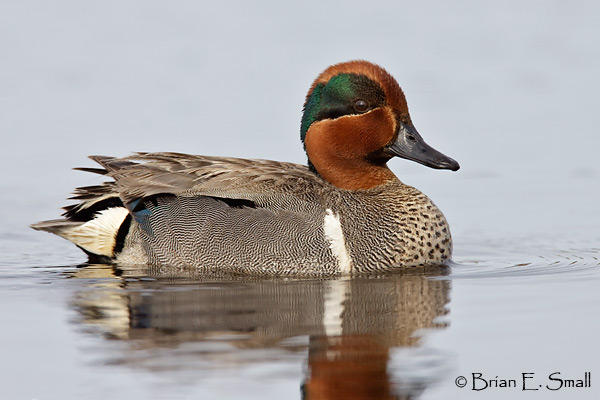
]]>

I met an Australian one spring morning many years ago in Central Park, NY; he was not a birder. We were both dressed in business attire and walking south along the Mall, but I had my binoculars around my neck and was taking a leisurely pace. He was a bit more hurried, but came over and asked me if I had just seen the same extraordinary bird that had been present only moments before. He had never seen anything like it and thought it must be some escapee from the zoo nearby. “Not very large, but not very small either”, he started. “The most marvelous blue color”, he continued. “Even the feathers on top of his head, which seemed to go up and down”. We walked the rest of the way south to 59th and I tried to find another Blue Jay to show him.
It’s funny how we can take something so easily for granted that will stop another man dead in his tracks. We see (and hear) so many Blue Jays in the eastern US that we hardly take time to notice them…but that does not make their beauty any less “extraordinary”. Blue Jays are unmistakable in appearance and are unlikely to be confused with any other species in Greenwich. Belonging to the same family as Crows, the upper parts of Blue Jays show various shades of blue with the wings and tail boldly marked with black bars and white tips. The under parts are grayish-white from the chin to the belly and (in varying degrees) show a black U-shaped collar across upper breast and sides of neck. The head has a large crest and dramatic black markings around the eye and behind the crest. The rich blue pigment in their feathers is melanin, which is actually brown. The blue color is caused by scattering light through modified cells on the surface of the feather barbs.

Blue Jays are quite vocal, and have a wide repertory of calls and alarms. Only found in North America, Blue Jays are resident in a very large range that covers the entire eastern seaboard from southern Canada to Florida, and as far west as the Great Plains. In Greenwich, Blue Jays are present year-round, although some regional migration patterns do exist. Every fall, hawk watchers at Greenwich Audubon tally thousands of Blue Jays, often in large flocks, passing overhead. Nevertheless, their migration is very poorly understood by researchers who estimate the actual proportion of jays that migrate to be less than 20 percent.
Blue Jays are long-lived and can easily reach well into their teens. The adapt well to humans and their populations are secure. That said, they prefer wooded areas to nest and forage, particularly around oak trees. They have a voracious appetite for acorns, sometimes carrying as many as 4 at time in their mouths, which they store for later feeding. Blue Jays are also monogamous, often mating for life.
]]> One of the nice things about birding is that you can always be surprised - even when something you see is actually expected to be around. This happened to me on a January Saturday when the winds were up and temperatures were down. Not expecting to brave the elements long, I drove over to the Audubon Center on Riversville Road just to check under the feeders - maybe see a Fox Sparrow or some Pine Siskins. As I came around the side of the main building to the feeder area, with the afternoon sun at my back, I saw a large flock of House Sparrows, some Chickadees and few Cardinals. Nothing out of the ordinary until a little rusty-capped sparrow hopped up in the brambles. I ended up retrieving the camera from my car and staying for an hour or so to get these photographs.

-
The American Tree Sparrow has somehow gotten to be one of my favorite winter finds. With a breeding range well into the tundra northern Canada and Alaska if you want to see Tree Sparrow in Greenwich, it will have to be between November and March. Not easily distinguishable to non-birders, these sparrows can be picked out from the crowd by their rusty cap and rusty (not black) eyeline on a gray head, a streaked brown back, and a smooth gray to buff belly with a dark smudge in the center of an otherwise plain breast. On closer inspection, you can discern the lower half of the bill, the mandible, to be yellow while the upper half is gray.
-
-
In winter, Tree Sparrows are frequent feeder guests, but I rarely seem to get them in my central Greenwich home. At Audubon the brambles and thickets come right up to the feeders, presenting a natural hide lacking at my house. Feeders are important because these sparrows are required to take in about 30 percent of their body weight in food (and a similar percentage in water) each day. A full day without food can be a death sentence as their body temperatures will drop and they lose a fifth of their overall body weight.
-
-
Owing to the remote breeding locations, humans have little effect on individuals in summer and conservationists are not worried about their numbers. But for me, just seeing one in winter is pleasure enough.
-
 Despite being year-round residents in our area, by late October Greenwich sees an influx of Hooded Mergansers. While some are still moving south in a regional migration, many more will stay in Greenwich and can be easily found on unfrozen lakes or shallow, protected saltwater bays. Good places to look are Eagle Pond at Greenwich Point or at Grass Island cove. Every year I even get a few pairs who stop over in the ice pod behind my house. Look for them mixed in flocks with other small divers like Bufflehead and Ruddy Ducks...given the stunning beauty of the male, they won’t be hard to find.
The smallest of three North American mergansers, drake Hooded Mergansers live up to their name and then some. With a large, black-bordered white crest that flashes into a fan the size of child’s hand, the male sets off his black back and white breast with 2 black stripes extending down the foresides. When crest is depressed, a thick white line extends back from the yellow eye. His sides and flanks are rufous-red. The often nearby female is brownish overall with a somewhat ragged cinnamon crest and whitish throat.

Like all mergansers, Hoodeds are diving ducks, hunters that capture small fish, aquatic insects, and crustaceans, particularly crayfish, with the aid of eyes well-adapted to underwater vision. This is accomplished with the aid of a “nictitating membrane” – essentially an extra eyelid which is transparent and helps protect the eye during swimming, like a pair of goggles. Merganser bills are thin and noticeably serrated to hang onto their prey once caught.
Hooded Mergansers breed in forested wetlands throughout the eastern half of North America and, skipping over the states of the great plain, also in the Pacific Northwest. They nest in tree cavities and also in treeless wetlands where people have put up nest boxes. Ducklings leave their nest cavity within 24 hours of hatching. With their mother calling from ground level, the chicks scramble up to the entrance hole and then flutter to the ground, which may be 50 feet or more below them. In some cases, monitors have witnessed day-old chicks walk half a mile or more with their mother to the nearest body of water.
While there is no reliable information on population size or status of this duck, given the relative stability of its native North American habitat, conservationists are not overly concerned about its ranks. The top image was photographed on a late afternoon in November at the top end of Rockwood Lake. The other images were taken in January near the boat slips in Greenwich Harbor.
]]>
 Ask any non-birder to name three backyard birds and “chickadee” is likely to fit in right behind Robin and Blue Jay. In part this is due to their love of feeders in winter (where they can routinely get more than 50% of their diet) and their relative security around humans. Chickadees are also fearless when it comes to human interaction. Give yourself enough time by the feeder with your hand extended, palm up, and at least one brave chickadee will come in for a landing to see what free tidbit may be on offer.
There are seven species of chickadee in North America, but in Greenwich we get the well-named Black-capped Chickadee, These small songbirds have cartoonishly round heads, small pointed bills and black eyes set into a black face mask that flares above the bill, over the head and down the nape. A similarly black throat and neck extend form the underside of the bill. Contrasting sharply are its bright white cheeks, breast and belly, save for its soft buffy sides. Looking down from the top, the Black-capped Chickadee has gray back, wing and tail, punctuated with white edgings along its primary wing feathers.
One of the most widespread birds in America, the Black-capped Chickadee is a non-migratory species found coast to coast, including much of Canada and the northern two thirds of the United States. Under rough winter conditions, individuals lower their body temperature at night and enter regulated hypothermia, saving significant amounts of energy. In addition, they hide seeds and other food items to eat later and have exceptional memories to relocate these stored treasures. Each item is placed in a different spot and the chickadee can remember thousands of hiding places.

Chickadees are often heard before being seen. Adults have been documented to have at least 16 different kinds of vocalizations but the most easily recognized is the “chick-a-dee-dee-dee” which is the obvious origin of its name. It is widely thought that the more “dee” notes in the phrase, the higher the birds’ perceived threat level.
While conservationists are not concerned about the population of Black-capped Chickadees across its broad range, there is some evidence in Connecticut of declining populations. Firs thought to be related to habitat lost, this theory has recently been replaced with the hypothesis that chickadees are in competition with the Tufted Titmouse, whose population is generally expanding in the northeast, including our home state.
]]>
 A favorite of backyard birdwatchers, the Tufted Titmouse is a common song-bird reident throughout the eastern United States. While there are a total of five species of Titmouse in North America, ours is the largest and most common, having an expanding range cornered by Vermont, Florida, Texas, and Michigan.
Frequent visitors to bird feeders during fall and winter, the Tufted Titmouse is easily identified by its the crest of gray feathers atop its head, its big black eyes, black forehead, and its rust-colored flanks contrasting nicely with gray back and off-white breast and belly. The rusty-brown wash along its flanks is tucked under the edge of its wing and not always noticeable. The short thin bill is black and the legs and feet are bluish-gray. The sexes are alike in color.
Like few other small song-birds, the voice of the titmouse resonates loudly with a clear two-syllable “peter-peter-peter” or a slightly more nasal “zhiii zhiii, zhiii”. In addition to feeder seed, titmice forage both in trees and on the ground,searching for caterpillars, beetles, ants, wasps, bees, spiders and other insects. Particularly in winter, they have a fondness for sunflower seeds and nuts, which they open by holding the seed in their feet and hammering with their bill.

Given their readily adaptable nature human surroundings and the feeders it frequents so regularly, the Turfed Titmouse in of no particular conservation concern. They do not migrate during the year and, in contrast to most species of titmice and chickadees, young titmice often remain with their parents during the winter and then disperse later in their second year. Juveniles are not easy to distinguish from their parents, but careful observation reveals a slight duller coloration overall.
These photographs of adult Tufted Titmouse were taken in my yard.
]]>

House sparrows were first introduced to North America in the 1850s and have become one of the most widespread birds in southern Canada, the continental United States, Mexico and Central America. They are highly adaptable to urban, suburban and agricultural habitats but are rarely found far from human habitation. Worldwide, I have seen these birds are also throughout Europe, South America, and India. One reason it is so widespread relates to a preference for nesting in manmade structures. Around town we see their spring nesting activity around our homes, shopping centers, and even in traffic light fixtures.
Considered quite drab by many standards, I find the male and female a delightfully handsome couple. The male has a forehead, crown and nape deep gray with a broad line of Chestnut behind eyes extending to sides and back of neck. The chin, throat, and chest are Black; making it instantly recognizable. A single wing bar is almost always present. The female is plainer, lighter brown throughout. On closer examination, however, she shows off subtle markings of a buff stripe behind eye crown and hindneck with more olive tones. While the throat an breast are unmarked, the base of the bill always reveals a hint of yellow.

Due to its abundance, ease to raise and general lack of fear towards humans, the House Sparrow has proved to be an excellent model organism for many avian biological studies. To date, there have been almost 5,000 scientific papers published with the House Sparrow as the study species.
House Sparrows in flocks have a pecking order much the way chickens in a farmyard do. You can begin to decipher the standings by paying attention to the black throats of the males. Males with larger patches of black tend to be older and dominant over males with less black. By wearing this information on their feathers, sparrows can avoid some fights and thereby save energy.
]]>
 The Mourning Dove is among the most abundant and widespread birds in North America, occurring in all of the lower 48 states, and into Mexico. As a habitat generalist, the species has benefited from human changes to the North American landscape and is a local resident in both rural and urban landscapes. Mourning Doves are found throughout Greenwich all year long, absent only in our most densely forested parks.
The mournful vocalization of this species is distinctively recognizable to birders in spring and summer and has given rise to its name. The male song is a “coo” followed by 2 or 3 louder “coos”, or “coo-oo-oo” advertising for a mate. Though not a vocalization, Mourning Doves also have a whistling flight sound, most noticeable at takeoff and landing, which is produced as air passes through the wings.

Mourning Doves are a tawny brown above and buffy below with black spots on the wings and behind eye. The wing and tail feathers are gray except for black-bordered white tips on tail (seen in flight). Mourning Doves are similar in size to their bluer cousin, the Rock Dove (Pigeon), but have a noticeably longer and more tapered tail. The soft eyes are dark brown bordered by bluish skin. The bill is narrow and black and the legs and feet are dull red.
Notwithstanding their large numbers, Mourning Doves are the leading game-bird in North America in terms of total harvest. Approximately one million hunters annually take more than 20 million birds, which exceeds the annual harvest of all other migratory game birds combined.
]]>
 At any time of the year, Greenwich is host to six different species of woodpecker. Of those, the Red-bellied Woodpecker may be the most common, and is certainly the easiest to distinguish from the others by both sight and sound. A medium-sized woodpecker with a zebra-patterned back, males have red forehead, crown, and nape which contrast strikingly with its gray face and breast. The “red belly” is so hard to see in the field that many consider the species poorly named, but as seen in the photo on the left, under the right viewing conditions a hint of red is indeed present. Females (photo at bottom) are similarly colored but only have red on the back of the neck (the “nape”) and not across the top of the head.
Red-bellied Woodpeckers prefer a mixture of pines and hardwoods and thrive equally at Greenwich Point as they do throughout town. In winter, the red-bellied is generally first to come to my feeder and feasts on suet as well as any manner of nuts, seeds or fruits that I happen leave out. Not known as even seasonal migrants, chances are the red-bellies that I see at my January feeder are the very same individuals that nest in the cavities of trees bordering my central Greenwich yard.

Often heard before seen, the Red-bellied has a distinctive “kiiiir” or “chuuuur” sometimes followed by a light-hearted warble that some refer to as “laugh”. Once spotted, this woodpecker can be easily followed as it hops up the tree-bark scanning for food.
Red-bellied Woodpeckers can be found almost anywhere east of the Mississippi River except for the far northern most reaches of our Canadian boarder states. Conservationists are Least Concerned about the Red-bellied today. Because the species inhabits a wide variety of forest types and nests in dead portions of live trees, the likelihood of it becoming threatened or endangered is much lower than most other woodpecker species in North America. These individuals were photographed in my yard
]]> The White-breasted Nuthatch, a favorite at feeders throughout the winter, is another year-round resident that can be found throughout Greenwich. Small, with bluish-gray wings with white trim, a white face, white breast and black cap (grayer in females), this nuthatch is often seen walking headfirst down branches and trunks. Other distinguishing characteristics include an exceptionally long, slightly upturned bill and some rusty-colored feathers under its short tail (see top inset).

Nuthatches probe the tree bark for seeds and insects. From the feeder, nuthatches will usually fly to a nearby branch to lodge a seed in a small crevice and use its sharp bill to pry open the husk. Males and females do not travel far and remain more or less in permanent territories throughout the year. Nests are formed in the cavities of older trees or abandoned woodpecker nests. These photographs are of two different individuals, one (top image) was photographed near the central parking area at Greenwich Audubon in late November and the other in my yard.

 Another year-round resident easily seen over nearly any body of water in Greenwich is the Ring-billed Gull. Routinely dismissed by non-birders as just another loud "seagull", the Ring-billed Gull is actually one of 27 different gull species found in North America, and is common across the US in far more diverse ecosystems than just near the sea. In Greenwich it is one of three species that occur throughout the year, but most serious birders in the area might tally as many as 8 species in a year by carefully looking through all the flocks that congregate on the beaches,

rivers and at the dumps and dumpsters around town (Holly Hill and Grass Island are as good a place to look as Greenwich Point.

Winter is a great time to practice on gull identification as the populations are stable and most migrant visitors have long passed through, reducing the risk of confusing species. The adult Ring-billed is true to its name with a clear black band circling its yellow bill near the tip. Other prominent characteristics of an adult in winter are the heavy gray streaks on it head (which turns completely white in summer - see inset at top). Coupled with its yellowish-green legs and feet, these characteristics are sufficient in winter for positive identification, but because gulls take 3-4 years to mature, the similarity of their plumage with other gull species in various ages of development can make gull identification a very challenging endeavor - one that only the most die-hard birders seem to relish.
With a nationwide population estimated at 3-4 million, the Ring-billed Gull is not considered a Concern by conservationists, but that was not always the case. In the late 1800's the species were considered a pestilence and was nearly wiped out by human predation.
]]>

Not only are cardinals year round residents in Greenwich, but they are extremely loyal to their area. Non-migratory, studies have shown that cardinals never stray very far from where they were born. In addition, male and female

pairs remain loyal to each other beyond the breeding season remaining together throughout the year on their breeding territory. Cardinals are not picky eaters whose interests favor insects, fruits and seeds, making them reliable and frequent guests to most bird feeders throughout the winter season. As a species they are highly adaptable to developed areas and are of Least Concern to conservationists. This pair of cardinals were photographed on the same day in my central Greenwich yard.
]]>

Black Ducks are common in the northeast US and Canada. New England states hold onto populations year round, with regional migration expanding their range from Newfoundland in the summer as far south as northern Florida in the winter. As common as they are in our area, Black Ducks are a favorite sporting bird and populations nosedived between 1950 and 1980, losing almost two-thirds of their total population. Pressure on coastal habitat also remain a challenge to this species in both the US and Canada, reducing breeding areas as well as over-wintering wetlands. Nevertheless, studies show that by 2000, winter populations had stabilized at roughly 300,000 individuals and the species is not presently considered Endangered.
This photograph was taken on a misty morning at Eagle Pond, but you can find these dabbling (not diving) ducks anywhere along the shore line shallows feeding on aquatic insects, crustaceans and small fry. In spring and summer it would not be uncommon to find them on inland fresh waters, but this time of year it is best to look for them by the sea.
